November 26, 2026
Nesting Yield, Scrap Allowance and Material Cost on a Fab Quote
13 min read
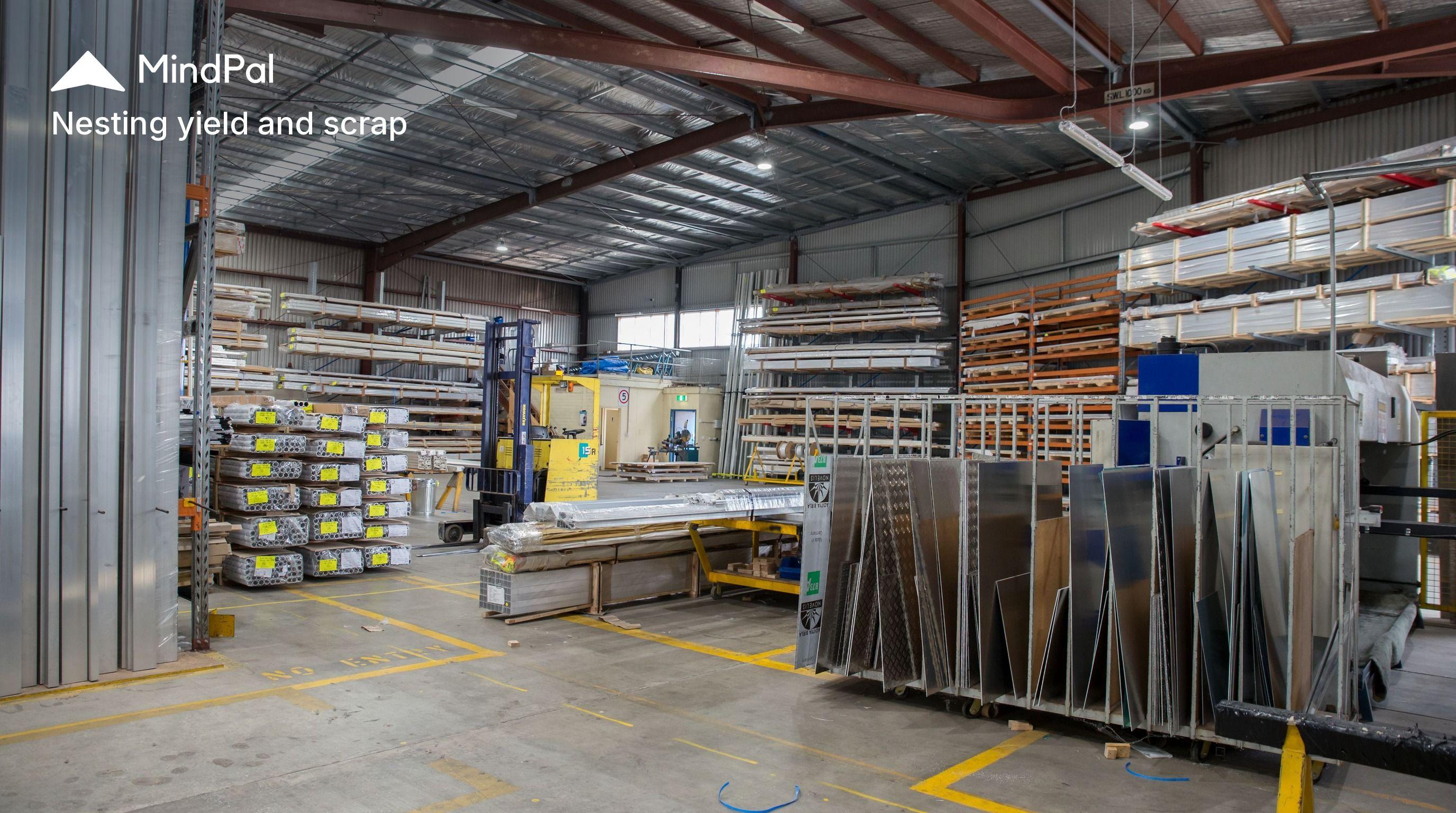
Material is often the biggest line on a sheet metal quote, and it is the one most often priced with a shortcut: part weight or part area, plus "10% for scrap." Sometimes that is close. Often it is not, and you only find out when the job is cut.
This guide covers how to cost material from the nest instead, how to handle remnants honestly, and how to check your assumptions after the job. It is the material step of how to quote sheet metal fabrication.
The short answer
Material cost per part should come from the nest: sheet price divided by parts per sheet, after kerf, part spacing and edge or clamp margins. That already includes the scrap that really happens. Do not add a flat scrap percentage as if it were a standard. Leftover sheet is scrap unless your shop has a real rule for keeping and reusing remnants.
Two terms help:
- Nesting yield (or material utilization) is the share of the sheet that ends up in good parts. The rest is kerf, web between parts, edge trim and the skeleton.
- Scrap allowance is the extra material a quote adds on top of the part's own size to cover that waste. If you cost from the nest, you do not need a separate allowance, because the nest is the allowance.
Why a flat scrap percentage mis-prices jobs
A single percentage assumes every part wastes the same share of a sheet. They do not.
- A rectangle nests tightly. A part with a big curve or a long thin leg leaves a lot of skeleton.
- A part that fits three times across a sheet with a strip left over wastes that strip on every row.
- A small order of a large part may use most of a sheet and leave an offcut nobody will use.
- Mixed nests share a sheet between several parts or jobs, and the split depends on how you allocate it.
So a flat allowance overprices parts that nest well (and loses you work) and underprices parts that nest badly (and loses you money). The same quote can do both at once.
Parts per sheet, kerf, web and clamp margins
The reliable method is short:
- Nest the part on the sheet size you actually buy, at the grade and thickness on the print.
- Use your real kerf, part-to-part spacing (web), edge trim and any clamp or gripper zone your machine needs.
- Count how many parts fit.
- Material per part = sheet price ÷ parts per sheet.
For a quantity that does not fill a whole number of sheets, decide how the partial sheet is charged: the whole sheet, the used portion, or the used portion plus a credit rule for the rest. Pick one rule and apply it every time.
For mixed nests, decide how you split the sheet between parts — by part area, by cut time, or by another rule — and document it. Without a rule, the biggest part in the nest quietly absorbs all the scrap.
The Fabricator, the trade magazine of the Fabricators & Manufacturers Association, notes in an article on material utilization in metal fabrication that filling sheets with extra parts can backfire if those parts sit as work-in-process and get lost or go obsolete. A tighter nest is only cheaper if the extra parts are actually needed.
Remnants: when an offcut is actually usable
An offcut is worth something only if three things are true: it is big enough to use, someone records it (material, thickness, size, location, and heat number if the customer needs traceability), and a later job actually uses it.
Keeping remnants is not free. The Fabricator's piece on the hidden costs of material utilization lists the labor to unload, label and store each remnant, the need for a system that suggests remnants before fresh stock, and the extra inventory accounting. If remnants pile up unused, they were scrap with extra handling.
A sensible rule for quoting:
- If your shop does not track and reuse remnants, charge the full sheet consumption and give no credit.
- If it does, credit only remnants above a size you really reuse, and only at a value you can defend.
- Do not credit the first job for a remnant and then also give the next job that material for free.
Machined parts: stock allowance vs. sheet yield
The same idea applies to CNC work, with different words.
A machined part starts from bar, plate or billet. The material line is the stock size the part is cut from — including facing, saw kerf, holding stock and any minimum length the supplier sells — not the finished part's weight. Chips are part of the cost, not waste you can ignore.
That is why the sheet metal method (nest and parts per sheet) and the CNC method (stock size per part) are kept separate. Both are in the cluster: how to quote a CNC machining job covers stock sizing.
How to write the material line on the quote
Make the material line something another estimator — or the customer — can follow:
- Grade, thickness and finish (for example, cold-rolled, galvanized, or a stainless finish)
- Sheet size used for the nest
- Parts per sheet, or sheets per order
- How partial sheets and remnants were treated
- Who supplies the material, and the date of the material price
Steel and other metal prices move. The U.S. Bureau of Labor Statistics publishes a producer price index for steel mill products, and it rose every month from June to October 2026. When prices are moving like that, a short validity period on the quote and a dated material price protect both sides.
What to review after the job
A quoted yield is a forecast. Check it.
- Compare sheets consumed on the job with sheets quoted.
- Note scrap parts, re-cuts and test pieces separately from nest waste.
- Check whether remnants you credited were really used.
- Look for patterns by part family, thickness and quantity, not one shop-wide number.
When quoted and actual yield keep drifting apart for a kind of part, change how you quote that kind of part. That review is also how the material line stays honest when someone new starts estimating.
Where software helps
The arithmetic is simple. The slow part is unfolding the part, nesting it on the right sheet, and doing it for every RFQ.
Quoting software can develop the flat blank, nest or estimate parts per sheet, and apply your sheet sizes and material prices, so every estimator gets the same material line for the same part. An estimator still decides whether a remnant rule applies and whether a nest is realistic for the quantity.
MindPal Forge is MindPal's quoting and estimating product for US and Canadian metal fabrication shops and machine shops. It reads the files shops actually receive — PDF, DXF, STEP, IGES, STL, scans, photos and ZIP packs — and calculates a cost from your machines, materials and rates, with a breakdown the estimator reviews. You can upload a DXF or STEP to the instant quote demo with no signup; it uses sample rates. For what else to check in a tool, see sheet metal quoting software. For the laser and brake lines that sit next to material, see how to estimate laser cutting cost and how to estimate press brake bending cost. For the rest of the cost model, see manufacturing estimating software.
Frequently asked questions
What is nesting yield?
Nesting yield, also called material utilization, is the share of a sheet that ends up in good parts. The rest is kerf, the web between parts, edge trim and the skeleton. It depends on the part shape, the sheet size, the quantity and what else is nested with it.
What is a scrap allowance on a fabrication quote?
It is extra material added to the part's own size to cover waste. If you cost material from the nest — sheet price divided by parts per sheet — you do not need a separate allowance, because the nest already includes the waste that really happens.
Should I cost material from the part outline or from the nest?
From the nest. The part outline or weight ignores kerf, spacing, edge margins and the skeleton. A flat percentage on top of the outline will overprice some parts and underprice others.
Do usable offcuts reduce the material cost?
Only if your shop really tracks and reuses them. Remnants cost labor to label, store and find. If they are not reused, they are scrap. Credit only remnants above a size you actually use, and do not count the same material twice.
How is scrap different on a CNC chip-making job?
A machined part is costed from the stock it is cut from — bar, plate or billet, including facing, saw kerf and holding stock — not from the finished weight. The chips are part of the material cost. Sheet metal is costed from the nest instead.
How often should yield be checked against actual usage?
Regularly, and by part family rather than one shop-wide number. Compare sheets quoted with sheets consumed on finished jobs, separate re-cuts from nest waste, and change your quoting method for any kind of part where the two keep drifting apart.
Share this blog post via
Read other articles
1 / 0
SOLUTIONS
CLIENTS
INSIGHTS

This site is protected by reCAPTCHA and the Google Privacy Policy and Terms of Service apply.
Copyright © MindPal 2026. All Rights Reserved.