November 26, 2026
How to Estimate Laser Cutting Cost
14 min read
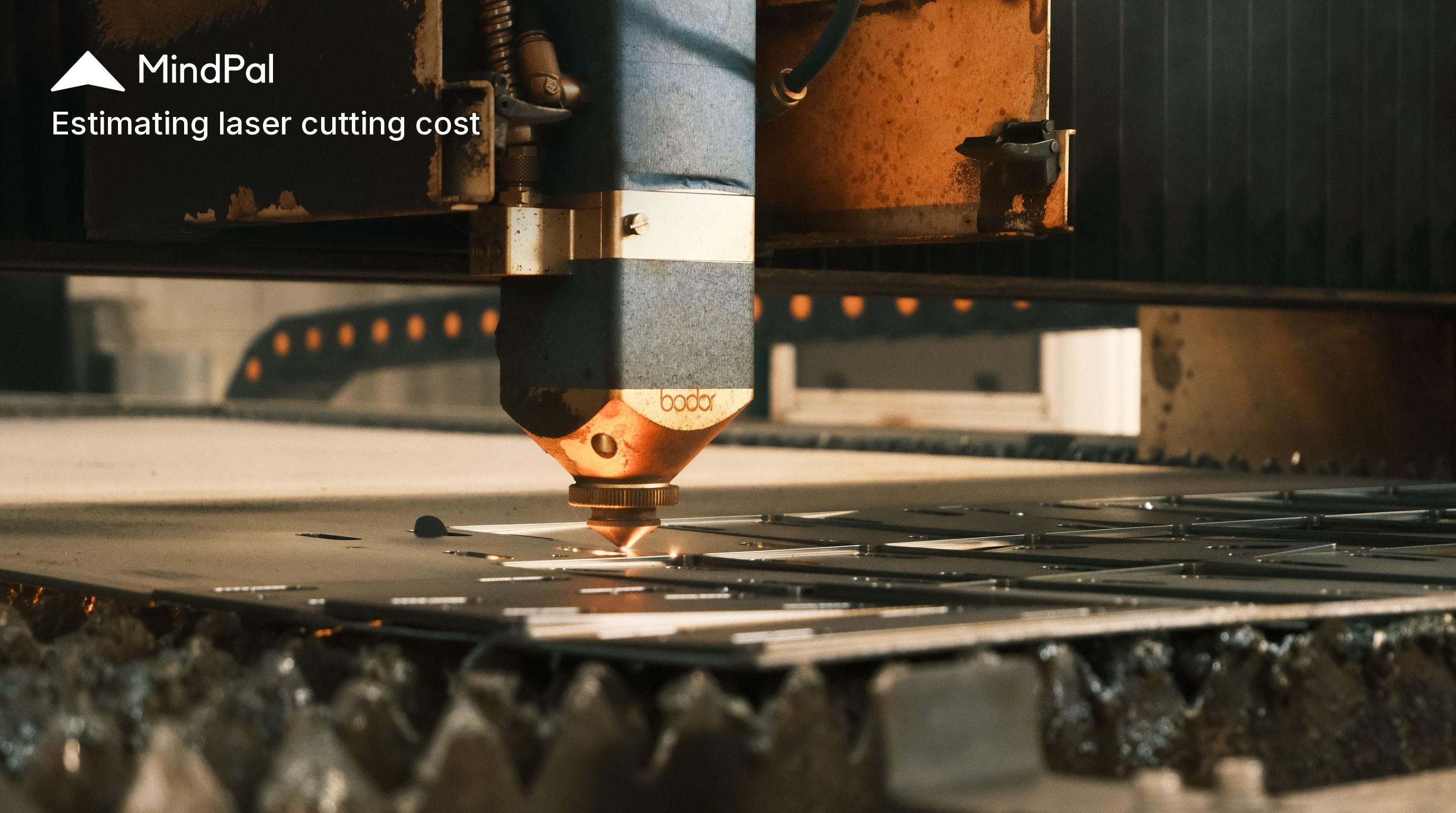
Two parts can have the same outline and cost very different amounts to laser cut. One is a plain bracket. The other has forty small holes. If your quote prices both by size or by length of cut alone, one of them is losing money.
This guide is the laser line of a sheet metal quote, step by step. For the whole fab job — forming, hardware, welding and finishing — see how to quote sheet metal fabrication. For software that does the measuring for you, see sheet metal quoting software.
The short answer
Laser cutting cost is machine time multiplied by the laser's shop rate, plus material taken from the nest, plus setup spread over the quantity. Machine time is cut length divided by cutting speed, plus pierce time for every hole and contour, plus rapid moves and handling.
In short:
- Machine time per part = cut length ÷ cutting speed + pierces × pierce time + rapids and handling
- Laser cost per part = machine time × laser shop rate
- Material per part = sheet price ÷ parts per sheet (from the nest)
- Setup per part = setup time × rate ÷ quantity
- Then add any assist-gas cost you carry separately, downstream work and margin
Every number in those lines should be your shop's own: your speeds, your pierce times, your rate, your sheet price.
Why pricing by length, area or weight goes wrong
Shortcuts are tempting because they are quick. Each one hides a cost.
- Per inch or per metre of cut ignores pierces. Each contour starts with a pierce, and on thicker plate a pierce takes real time. A hole-heavy part can spend more time piercing than cutting.
- Per square foot of part ignores the nest. A small part with an awkward shape can waste most of a sheet. A large, simple one can nest tightly.
- Per pound ignores machine time almost entirely. Light, intricate parts get underpriced; heavy, simple ones get overpriced.
These shortcuts are fine for a rough number on the phone. They are not a quote.
The machine-time formula: cut, pierce, rapids
The Fabricator, the trade magazine of the Fabricators & Manufacturers Association, describes a standard laser formula in its guide to estimating basics in custom metal fabrication: linear inches of cut divided by cutting speed in inches per minute, plus number of pierces times pierce time, then multiplied by the department's hourly rate. That is the core of it.
Fill it in like this:
- Cut length. Every contour the head follows: the outside profile plus every hole, slot and cutout. Take it from the DXF or the flat pattern, not from the overall dimensions.
- Cutting speed. From your cut chart for that material, thickness and assist gas, adjusted to what your operators actually run for the edge quality you promise. Brochure speeds are a ceiling, not a plan.
- Pierces. Usually one per contour. Pierce time grows with thickness, so count it separately rather than burying it in the speed.
- Rapids and handling. Head moves between features, sheet loading and unloading, and removing parts from the skeleton. On automated cells some of this overlaps with cutting; on a manual table it does not.
The article also notes that estimators refine the formula over time — for example, adding part-removal time, or a helper knocking thick parts out of the skeleton. Start simple, then add the terms your jobs prove you need.
Material from the nest, not from the part outline
Material is often the biggest line on a laser part, and it should come from the nest.
Nest the part on the sheet size you buy, count parts per sheet, and divide the sheet price by that number. Kerf, part spacing, edge margins and the skeleton are all included that way. Do not add a flat scrap percentage on top of part area as if it were a standard; yield depends on the shape, the sheet and what else is on it.
If you keep and reuse remnants, decide when an offcut gets credit, and apply the rule the same way on every quote. If remnants go in the scrap bin, the job bought the whole sheet. The same reasoning appears in how to quote sheet metal fabrication. The full material method is in nesting yield, scrap allowance and material cost.
Setup and quantity
Setup is paid once per job: programming and nesting, loading material, checking the first part, and sorting and stacking the parts afterwards.
Divide setup by the quantity. On a run of five parts, setup can be most of the laser cost. On a run of five hundred, it barely moves the unit price. This is why one price for every quantity is a mistake; quote at least two quantities so the customer can see the difference.
A minimum charge covers the very small job that would otherwise leave you with all of the setup and almost none of the parts.
Assist gas, thickness and hole-heavy parts
A few things change the laser line more than people expect.
Assist gas. Oxygen is common on mild steel; nitrogen is common on stainless and aluminum, and where a clean, oxide-free edge is needed. The gas changes cutting speed, running cost and what happens next. The Fabricator notes in a piece on high-power cutting that nitrogen-cut stainless edges can go straight to welding, while oxide left by oxygen cutting has to be removed first for a sound weld. That grinding is a real cost, even if it happens in another department. Some shops carry gas inside the laser rate; others add it as its own line. Either works if you are consistent.
Thickness. Speed falls and pierce time rises as plate gets thicker. Use your chart for each thickness rather than scaling from one number.
Hole-heavy parts. Perforated panels, vent patterns and parts with many small holes are driven by pierce count and short moves, not by cut length. Count the holes.
Material and finish. Reflective materials, coated sheet, film-protected sheet and tight edge-quality requirements can all slow the cut. If the customer asks for a cosmetic edge, price it.
The Fabricator's article on laser cutting profits in sheet metal shops groups the real cost of a laser part into equipment, job costs such as material and assist gas, and labor. A quote that covers all three, at your rates, is one you can defend.
A worked example with placeholder inputs (illustrative only)
This is the shape of the calculation, not a price. Every letter stands for a number from your own shop.
A flat part has a cut length of L inches across all contours and P pierces. Your cutting speed for that material and thickness is S inches per minute, your pierce time is p seconds, and rapids and handling add r minutes per part. The laser's shop rate is R per hour.
- Machine time per part, in minutes = L ÷ S + (P × p ÷ 60) + r
- Laser cost per part = machine time ÷ 60 × R
The nest fits N parts on a sheet that costs M, so material per part = M ÷ N.
Setup takes T minutes at rate R, and the order is Q parts, so setup per part = T ÷ 60 × R ÷ Q.
Add laser cost, material and setup per part, then any separate gas line, downstream operations and margin. Run it again at a second quantity, and you will see why the unit price should change.
To build R properly — from loaded labor, machine cost and overhead over billable hours — see how to calculate a shop rate.
How software uses the nested file
The formula is short. Getting the inputs is not: measuring cut length, counting pierces, unfolding a bent part, and building a nest for every RFQ.
Quoting software can read the DXF, STEP or PDF, measure cut length and pierces from the geometry, take material from a nest, and apply your laser rate and setup times, so every estimator gets the same answer for the same part. An estimator still checks the speed assumptions, the nest and the lead time.
MindPal Forge is MindPal's quoting and estimating product for US and Canadian metal fabrication shops and machine shops. It reads the files shops actually receive — PDF, DXF, STEP, IGES, STL, scans, photos and ZIP packs — and calculates a cost from your machines, materials and rates, with a breakdown the estimator reviews before the quote goes out. You can upload a DXF to the instant quote demo with no signup; it uses sample rates, so judge the read and the breakdown, not the price.
For how Forge compares with other tools, see the 13-tool manufacturing quoting software comparison. For the rate side of the cost model, see manufacturing estimating software.
Frequently asked questions
How do you calculate laser cutting cost?
Work out machine time — cut length divided by cutting speed, plus pierce time for each contour, plus rapids and handling — and multiply it by the laser's shop rate. Add material from the nest (sheet price divided by parts per sheet), setup divided by quantity, any separate assist-gas cost, downstream operations and margin.
Why isn't cut length enough to price a part?
Because every hole and contour needs a pierce, and pierces take time that cut length does not show. Two parts with the same outline can take very different times if one has many holes. Material also depends on how the part nests, not on its cut length.
How do pierces change the quote?
Each pierce adds a fixed time before the cut can start, and that time grows with material thickness. Count pierces from the flat pattern and multiply by your pierce time for that material and thickness. On hole-heavy parts, piercing can be a large share of machine time.
Should material be costed from the part area or from the nest?
From the nest. Sheet price divided by parts per sheet includes kerf, spacing, edge margins and the skeleton. Part area plus a flat scrap percentage will over-price some parts and under-price others.
How does quantity change a laser-cutting quote?
Setup — programming, nesting, loading and first-part checks — is paid once per job. Dividing it by a larger quantity lowers the unit price. Larger quantities can also nest better. Quote at least two quantities, and use a minimum charge for very small runs.
Does a fiber laser and a CO2 laser get the same rate?
Not necessarily. They have different purchase costs, running costs and speeds on different materials and thicknesses. Give each machine its own shop rate and its own cut chart rather than one blended laser rate. See how to calculate a shop rate.
Share this blog post via
Read other articles
1 / 0
SOLUTIONS
CLIENTS
INSIGHTS

This site is protected by reCAPTCHA and the Google Privacy Policy and Terms of Service apply.
Copyright © MindPal 2026. All Rights Reserved.