September 29, 2026
Registered Nurse Resume: How to Pass ATS and Get More Interviews
14 min read

In this article, you'll discover:
What nurse recruiters and unit managers check first on an RN resume
- The best format and section order for a nursing resume
- How to write a professional summary with a real achievement
- How to list your RN license and certifications so they pass ATS
- How to turn clinical duties into bullets with numbers and results
- Which clinical skills to include, and tips for new graduate nurses
- Common nursing resume mistakes, a checklist, and answers to the questions nurses ask
Nurses are in demand across the US, but that doesn't mean every application gets a reply. Hospitals and health systems often receive many applications for each opening, and most of them use an applicant tracking system (ATS) to sort resumes before a nurse recruiter sees them. If you've been sending applications and hearing nothing, here's what's usually going on.
A strong nursing resume has to do two jobs at once. It has to get through the software, and it has to show a busy hiring manager in seconds that you're safe, qualified and a good fit for their unit.
This guide walks you through each section of a registered nurse resume: what to include, how to list your license and certifications, and how to write bullets that show real clinical impact. Want feedback on your current resume first? Run it through the free MindPal Resume Checker.
What Hiring Managers Look For in an RN Resume
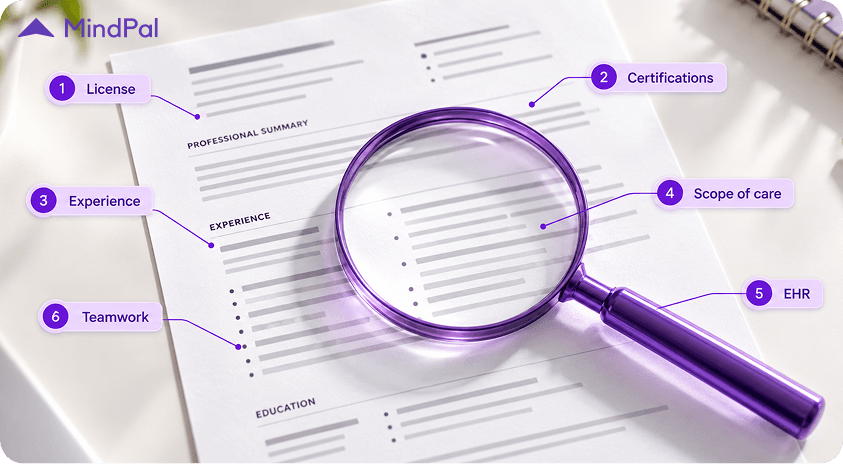
Before you start writing, it helps to know what the reader is checking. Most nurse recruiters and unit managers scan for the same things, roughly in this order:
- An active RN license in the right state, or a multistate compact license
- Required certifications such as BLS, plus ACLS, PALS or specialty credentials, depending on the unit
- Relevant clinical experience in the same or a similar specialty and setting
- Scope of care: unit type, bed count, patient population and patient ratios
- The EHR systems you've used, since training time costs money
- Signs of reliability and teamwork, such as precepting, charge nurse shifts and committee work
If this information is hard to find on your resume, it may be skipped, even if you're a great nurse. This is why every resume should be polished to its industry, and healthcare is no exception.
The Best Format for a Nursing Resume
For most nurses, a reverse-chronological format works best: your most recent position comes first. It's what recruiters expect, and it's what ATS software reads most reliably. Use these section headings, in this order:
- Contact information
- Professional summary
- Licenses and certifications
- Clinical experience (or Work experience)
- Clinical skills and competencies
- Education
New graduates can move Education above Experience and add a Clinical Rotations section.
Keep the design simple. Use standard headings, a clean font and no tables, text boxes or graphics for important content, since some ATS tools can't read them. One page is ideal for new grads (see our one-page resume tips). Two pages are fine for experienced nurses with several roles or specialties. For more on formatting, read how to turn ATS from an enemy into your best friend. If you'd rather not start from a blank page, build your resume in the MindPal Resume Builder.
1. Contact Information
Include your full name, followed by your credentials (for example, "Avery Morgan, RN, BSN"). Add your city and state, phone number, a professional email address and, if it's up to date, your LinkedIn profile.
You don't need your full street address. Your city and state are enough, and they help recruiters hiring locally.
2. Professional Summary
Your summary is two to four lines at the top of your resume. It should answer three questions: what kind of nurse are you, where have you worked, and what have you achieved?
Weak example: "Hardworking and compassionate nurse looking for a new opportunity to grow my career."
Strong example: "Registered Nurse with 5 years of ICU and medical-surgical experience in Level I trauma care. Calm under pressure, focused on patient safety and clear family communication. Led a unit-wide sepsis screening rollout."
The strong version names the specialty, the setting and a concrete achievement. If you're applying to a specific unit, adjust the summary so it matches that unit. For more examples, read How to Write a Perfect Resume Summary.
3. Licenses and Certifications
In nursing, this section often decides whether your resume moves forward, so don't hide it at the bottom. Place it right after your summary. For your license, include:
- License type (Registered Nurse)
- The issuing state, or "Multistate (Compact) License" if you hold one under the Nurse Licensure Compact
- The expiration date
Many nurses leave their license number off the resume and share it later in the hiring process. Follow the employer's instructions if the application asks for it.
For each certification, include the full name, the issuing organization, and the issue and expiration dates. Recruiters need to see that your credentials are current. For example:
- Registered Nurse, Texas Board of Nursing (Multistate License), expires 06/2027
- Basic Life Support (BLS), American Heart Association, expires 04/2027
- Advanced Cardiovascular Life Support (ACLS), American Heart Association, expires 04/2027
- Critical Care Registered Nurse (CCRN), AACN, expires 09/2028
Spell out every acronym at least once. The ATS might search for "Advanced Cardiovascular Life Support" while a person searches for "ACLS," so including both covers you either way.
4. Clinical Experience
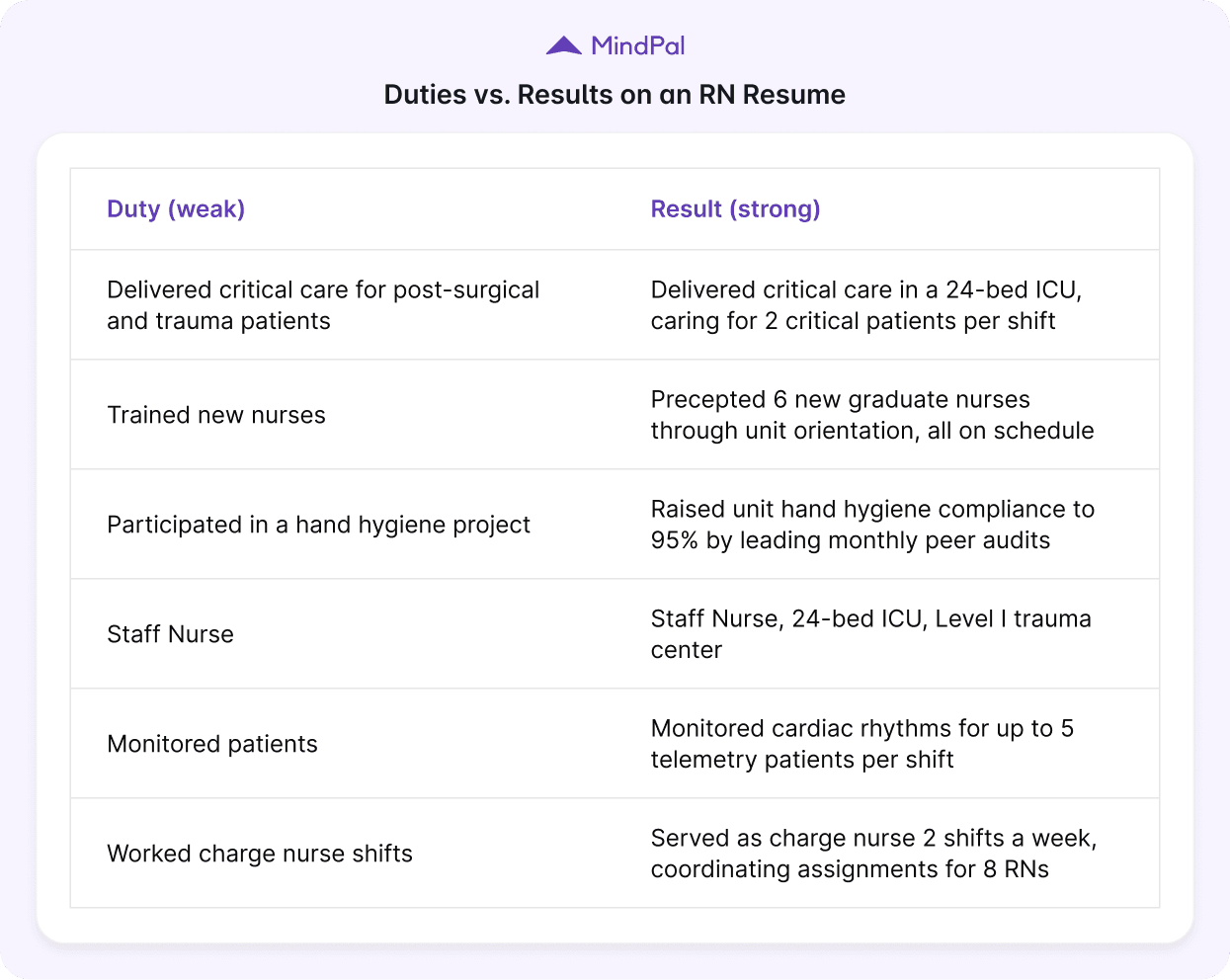
This is where most nursing resumes lose impact. Many nurses list duties that every RN performs ("administered medications," "monitored patients," "documented care"). Those lines don't tell a hiring manager anything that sets you apart.
For each role, include your title, the facility name, the city and state, your dates, and a short line on the unit: type, bed count and patient population. Then write three to six bullets that show scope and results.
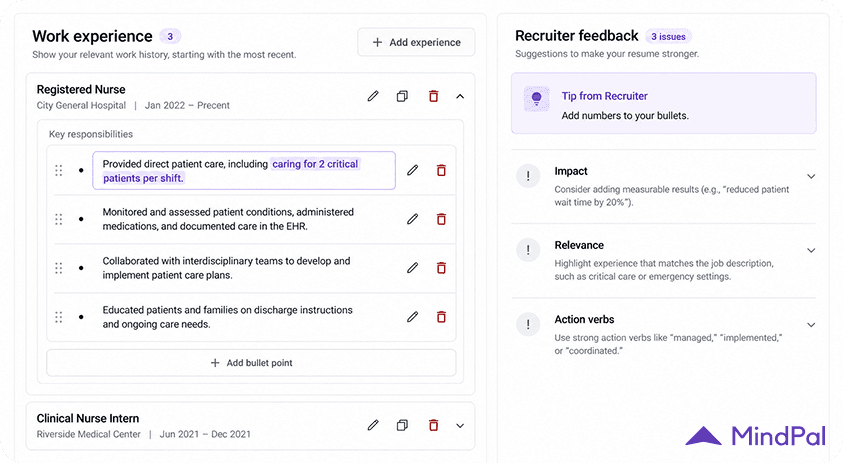
Add numbers wherever you can. Patient ratios, bed counts, number of nurses precepted, audit scores and response times all make your experience concrete.
Lead with results. Put the outcome at the start of the bullet, then explain how you achieved it. Starting with a strong action verb helps.
Show leadership and initiative. Charge nurse shifts, rapid response team membership, shared governance committees, quality improvement projects and super-user roles for new equipment or EHR updates all show that you contribute beyond your assignment.
Only use numbers you can stand behind in an interview. If you don't have exact figures, describe scope honestly, for example "on a 32-bed medical-surgical unit." For more help with bullet writing, see How to Nail Your Resume with Awesome Bullet Points. If you use AI to polish your wording, follow our guide to improving your resume with AI without getting flagged by recruiters.
Duties vs. Results on an RN Resume
5. Clinical Skills and Competencies
A single long list of skills is hard to scan. Group your skills into clear categories so recruiters, and the ATS, can find what they're looking for:
- Clinical skills: patient assessment, IV therapy and line care, medication administration, wound care, ventilator management, telemetry monitoring
- Specialty skills: titration of vasoactive drips, post-operative recovery, trauma care, sepsis protocols
- Systems and equipment: electronic health records such as Epic or Cerner, infusion pumps, cardiac monitors, bedside glucose testing
- Communication and teamwork: patient and family education, interdisciplinary rounds, handoff reporting, precepting
Match your wording to the job description. If the posting says "telemetry monitoring," use that exact phrase instead of a general term like "patient monitoring," as long as it's true for you. Our guide on matching your resume to a job offer explains how to do this without keyword stuffing.
6. Education
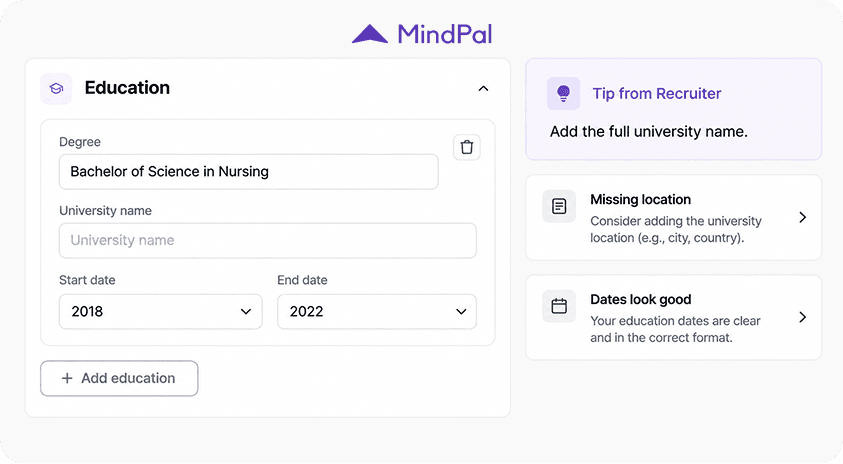
List your nursing degree (ADN, BSN or MSN), the school, its city and state, and your graduation year. Experienced nurses can keep this section short. New grads can add honors, a relevant capstone project or a strong GPA.
Tips for New Graduate Nurses
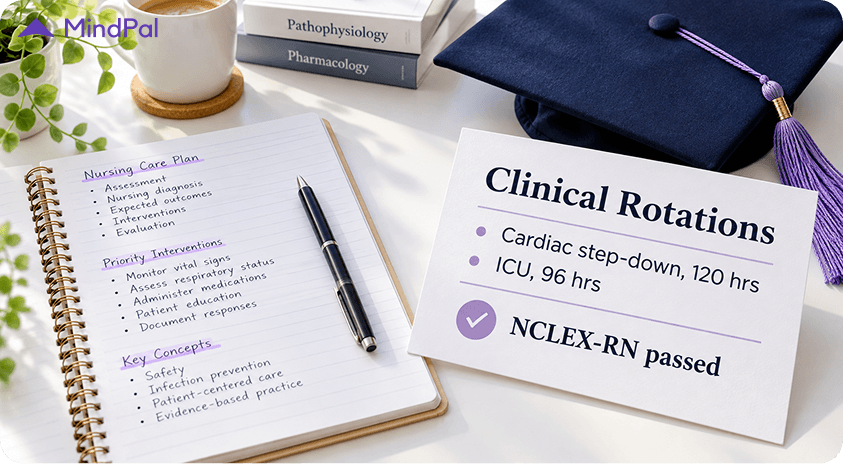
If you've just passed the NCLEX-RN, your clinical rotations are your experience. Treat them like jobs:
- Add a Clinical Rotations section with the facility, unit, and number of clinical hours for each rotation
- Describe what you did, for example "Cared for 2 to 3 patients per shift on a cardiac step-down unit under RN supervision"
- Highlight your capstone or preceptorship, especially if it was in the specialty you're applying to
- Include any healthcare work experience, such as patient care technician, CNA or EMT roles
Apply to new graduate residency programs as well as open roles. Many hospitals hire new grads through these programs. For more first-job advice, read our entry-level resume guide for US college graduates.
Common Nursing Resume Mistakes
Missing or outdated certifications. An expired BLS can mean an automatic no.
- Listing duties instead of results. Every RN gives medications, so show what made your care stand out.
- No unit details. "Staff Nurse" tells a recruiter far less than "Staff Nurse, 24-bed ICU, Level I trauma center."
- One resume for every job. An ICU resume and a clinic resume should highlight different skills.
- Hard-to-read formatting. Tables, columns and graphics can confuse ATS software.
- Typos and inconsistent dates. In a profession built on accuracy, small errors stand out.
For a broader list, see 10 Resume Mistakes That Could Cost You a Job and Why Your Resume Is Not Getting Responses.
Check Your Nursing Resume in Minutes
It's hard to review your own resume objectively. The free MindPal Resume Checker gives you feedback built for your field:
- Select Healthcare as your industry
- Upload your resume as a PDF
- See your overall resume score, with issues sorted into Urgent Fixes, Optional Fixes and Strengths
- Read each Tip from Recruiter, such as adding patient load to an experience bullet or adding dates to your certifications
- Switch on Edit mode and fix each section in the builder, then preview and export your updated resume
Find Nursing Jobs That Fit Your Resume
When your resume is ready, browse open roles on the MindPal job board and use job matching to see how well your resume fits each offer. Choose Improve this resume to tailor it for the role you want most. Not sure which roles to target? Read how to find the jobs that actually fit you.
Nursing Resume Checklist
Run through this quick list before you apply:
☐ Your name includes your credentials (RN, BSN)
☐ Your summary names your specialty, your setting and one achievement
☐ Your license lists the state or compact status and its expiration date
☐ Every certification has an issuer and dates, and acronyms are spelled out
☐ Each role includes the unit type, bed count or patient population
☐ Bullets include numbers and lead with results
☐ Skills are grouped and match the job description where true
☐ The format uses standard headings, with no tables or graphics
☐ The file is a PDF with a clear name, such as firstname-lastname-rn-resume.pdf
Frequently Asked Questions About Nursing Resumes
Should I put my nursing license number on my resume?
It isn't required. Many nurses list the license type, state and expiration date, then provide the number during the application or onboarding process. Follow the employer's instructions if they ask for it.
How long should a nursing resume be?
One page for new graduates and early-career nurses. Two pages are fine if you have several years of experience across multiple roles or specialties.
What skills should I put on a nurse resume?
Include clinical skills relevant to the unit, specialty skills, the EHR systems you've used, and communication skills such as patient education and handoff reporting. Match the wording to the job description where it truthfully applies.
How do I make my nursing resume ATS-friendly?
Use standard section headings, a simple single-column layout and the keywords from the job posting. Spell out certification acronyms, and avoid putting important details in tables, headers or images. You can check how your resume performs with the MindPal Resume Checker.
Should new grad nurses include clinical rotations?
Yes. List each rotation with the facility, unit and hours, and describe the patient care you provided. For many new grads, rotations are the strongest part of the resume.
Get Your Nursing Resume Interview-Ready
Your clinical skills are what make you a great nurse. Your resume is what gets you in the door. Show your scope, prove your impact with numbers, keep your credentials current and visible, and tailor each application to the unit.
Check your nursing resume with MindPal Resume Checker, see what recruiters would flag, and fix it in minutes. Then browse nursing jobs that fit your resume.
Related: Resume Checker · Job Board · Resume Builder · Bullet Points Guide · Career Guides
Note: All names, facilities and figures in the examples are fictional and shown for illustration only.
Olga Nazarenko,
UX UI Designer,
MindPal.co
Share this blog post via
Read other articles
1 / 0
FOR BUSINESS
Manufacturing for construction
Recruitment
FOR INDIVIDUALS
SOLUTIONS

This site is protected by reCAPTCHA and the Google Privacy Policy and Terms of Service apply.
Copyright © MindPal 2026. All Rights Reserved.