August 24, 2026
You Are Applying to the Wrong Jobs. Here Is How to Find the Ones That Fit.
18 min read

In this article, you'll discover:
- Why "apply to more jobs" quietly makes your search harder, not easier
- What recruiters really mean when they talk about a resume "matching" a role
- How ghost jobs and blind applying waste your best effort
- Two short stories of people who stopped guessing at fit and started getting calls
- A simple way to see your match to a real job before you spend energy on it
- A checklist to run before your next application
- Clear answers to the questions you are quietly asking
Let me guess how your search has been going.
You open a job board and scroll. A role looks interesting, so you apply. Another looks close enough, so you apply to that too. By the end of the week you have sent fifteen applications into fifteen different forms, and you have almost no idea which ones you were actually a strong fit for. You just know you did the work. And then you wait, and mostly you hear nothing.
Here is the quiet problem underneath all that effort: you cannot see the fit. Every application is a small bet placed in the dark, and when the bets do not pay off, it is easy to decide the problem must be you.
I want to say this plainly. It usually is not you. You are aiming without a target, pouring real energy into roles you may only half match, while the roles you would clearly win sit two clicks away, unnoticed. The good news is that fit is not a mystery anymore.
You can see it before you apply.
It Is Not That You Are Not Good Enough. You Cannot See the Fit.
When applications go quiet, most people reach for the same two conclusions: either I am not qualified, or I need to apply to more. Both feel true. Both usually make things worse.
The real issue is information. You are looking at a job post that lists ten things, written in the company's language, and trying to guess in your head whether your experience lines up. That guess is where the whole search goes wrong. Some people guess too high and apply to everything, sure that enthusiasm will carry them. Others guess too low and talk themselves out of roles they would be great at.
Fit is not a feeling you have to guess at. It is something you can measure. Once you can see how your resume actually stacks up against a specific role, you stop betting in the dark and start spending your energy where it can pay off.
Why Guessing at Fit Quietly Costs You
Blind applying is not just tiring. It works against you in three specific ways.
You waste effort on jobs that were never real.
In a recent survey of 1,000 US professionals, 47% said they had applied to a role they later found never existed at all. Companies post these "ghost jobs" to look like they are growing or to build a pipeline for later. When you apply blind, you cannot tell a real opening from a phantom one.
You spread yourself too thin.
When nothing lands, applying to more feels like the answer. But a flood of half-matched applications does not raise your odds. It lowers the care behind each one and burns you out. Ten applications you clearly fit will beat fifty you do not.
You filter yourself out of the right ones.
This is the quiet one. Faced with a post listing ten requirements, many strong candidates count the two they lack and close the tab. A well-known Harvard Business Review finding captured the pattern: people often will not apply unless they feel almost fully qualified, even though most roles do not require it. Apply only to jobs you meet 100% on paper, and you skip the ones you would actually get.
Notice that none of these are about your ability. They are about visibility. You cannot aim at what you cannot see.
What "Match" Actually Means to a Recruiter
When a recruiter or a hiring system looks at your resume against a role, they are not reading it like a story. They are scanning for overlap: do the skills, the titles, and the top few requirements in this posting show up clearly in this resume, in the first few seconds?
That overlap is what "match" means, and it is more powerful than most people realize.
- Candidates who tailored their resume to the job description were about 31% more likely to land an interview than those who sent a generic one, according to a ResumeGo study.
- Simply matching the job title from the posting on your resume made applicants 3.5 times more likely to get an interview, per Job analysis.
- A large majority of recruiters, around 83%, say they prefer applications clearly tailored to the role.
And the baseline they are working against is brutal: fewer than 3% of resumes typically turn into interviews. That is exactly why match matters so much. In a stack where almost everything gets passed over, the resume that visibly fits is the one that survives the skim.
The takeaway is not "rewrite everything for every job." It is "know your real match first, then close the small gap that stands between you and a yes."

Two Short Stories
Consider Priya, who was doing everything the hard way.
Priya was a marketing coordinator with three solid years of experience, applying the way most people do: scrolling a big job board, picking anything that looked close, sending the same resume every time. Forty applications in a month, a handful of rejections, and mostly silence. She had started to believe she was reaching too high.
One evening she tried something different. Instead of guessing which roles fit, she uploaded her resume once and looked at how it scored against each opening. The picture surprised her. The flashy "senior" roles she had been chasing came back as weak matches. But a cluster of roles she had been scrolling right past were sitting at 88% and 91%. She had been aiming at the wrong shelf the whole time.
There was one more thing. Those strong matches flagged two skills she was apparently missing, except she was not missing them at all. She had run analytics dashboards and managed a small budget for a year, and had simply never written either down. She added them in the exact words the roles used, and pointed herself only at the roles she genuinely fit. Within three weeks she had two first-round calls. Nothing about her experience had changed. She had just stopped guessing and started aiming.
Then there is Devon, who had the opposite instinct.
Devon was moving from teaching into instructional design, and he kept talking himself out of applying. Every posting listed ten things, and he could always find the two he did not have, so he closed the tab. He assumed he needed to meet all of it to have a shot.
When he finally checked how his resume matched a role he liked, instead of judging it in his head, the number stopped him: 79%. He was not the long shot he had decided he was. Better still, he could see exactly what the gap was, two specific skills, not a vague sense of "not enough." One he could genuinely claim once he reframed a project he had led. The other he named honestly as something he was building toward. He fixed the framing, matched the language of the role, and applied to a job he would have skipped a week earlier. Ten days later, a recruiter called. The barrier had never been his ability. It was a number he had guessed instead of checked.

How to Find Jobs That Actually Fit
Here is the method underneath both turnarounds. It is not about applying more. It is about seeing the fit before you spend a single minute on the application.
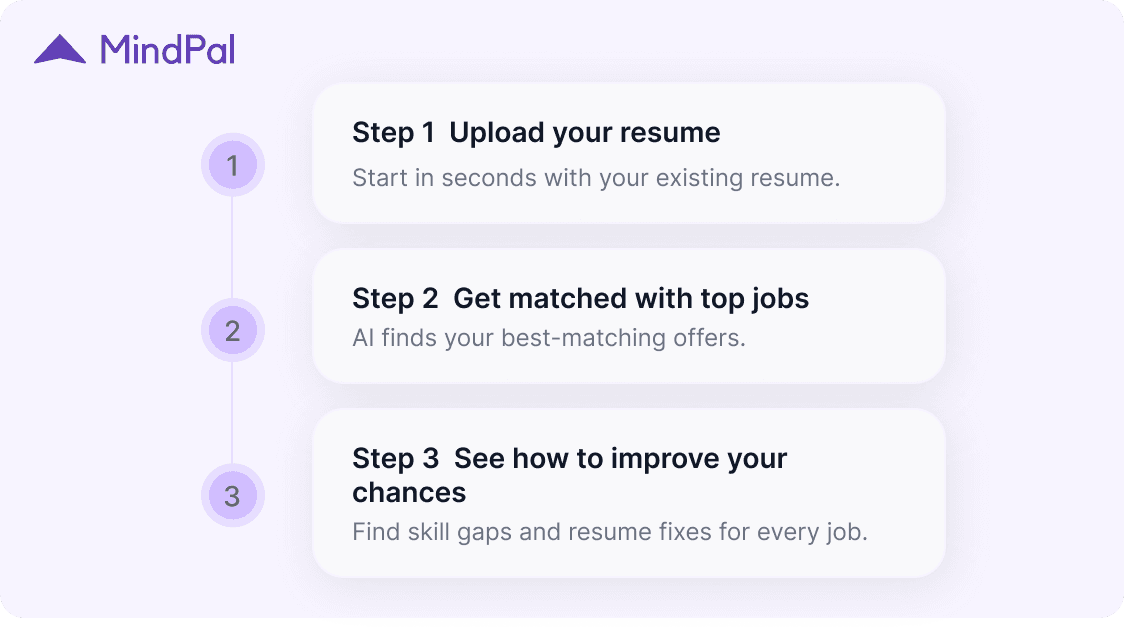
1. Upload your resume once, then let the fit come to you.
Instead of reading each posting and guessing, upload your resume a single time and see your match score against every role at a glance. The roles you clearly fit rise to the top, and the ones you do not stop stealing your attention.
2. Sort by fit, not by title.
The most impressive-sounding role is not the one most likely to answer. Start with your strongest matches, even the ones that feel a little too comfortable. Comfortable often means you will get the interview.
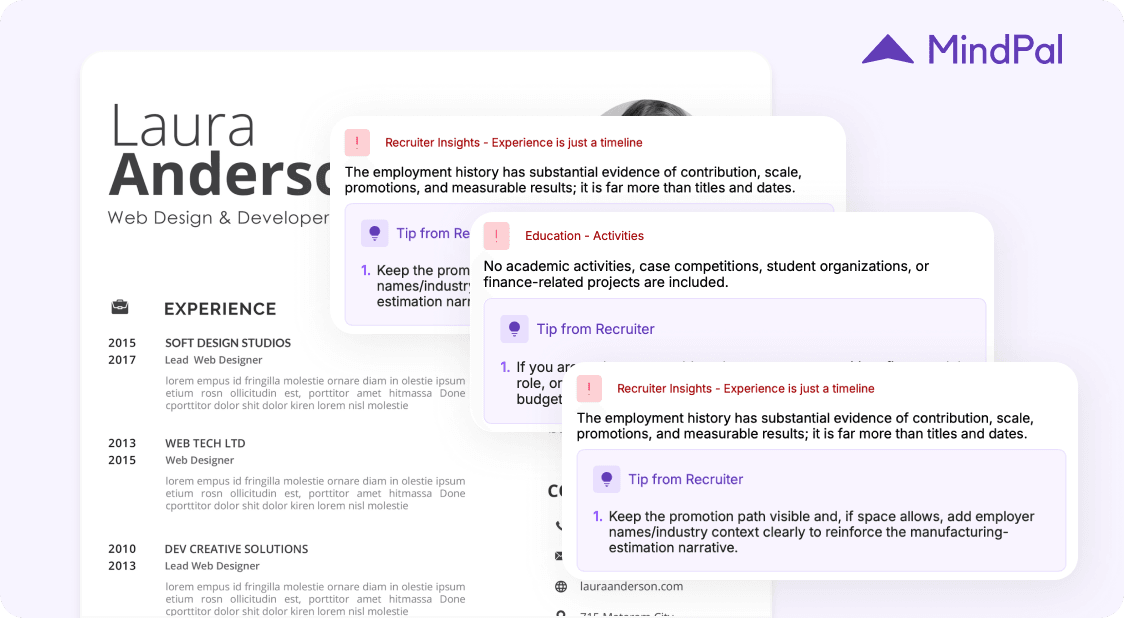
3. Read the gap, do not guess it.
When a role is a near match, you want to know the two or three things standing between you and a perfect fit, in plain terms. A specific gap is fixable. A vague fear is not.
4. Close the small gaps honestly.
Often the "missing" skills are things you have done and never listed. Add them in the role's own language. When a gap is real, name what you are building toward rather than hiding it.
5. Then, and only then, apply.
By the time you hit submit, you already know this role is real, recent, and a genuine fit. That is the application that gets a reply.
The whole point is to move the thinking to the front, before you invest the effort, instead of after another month of silence.
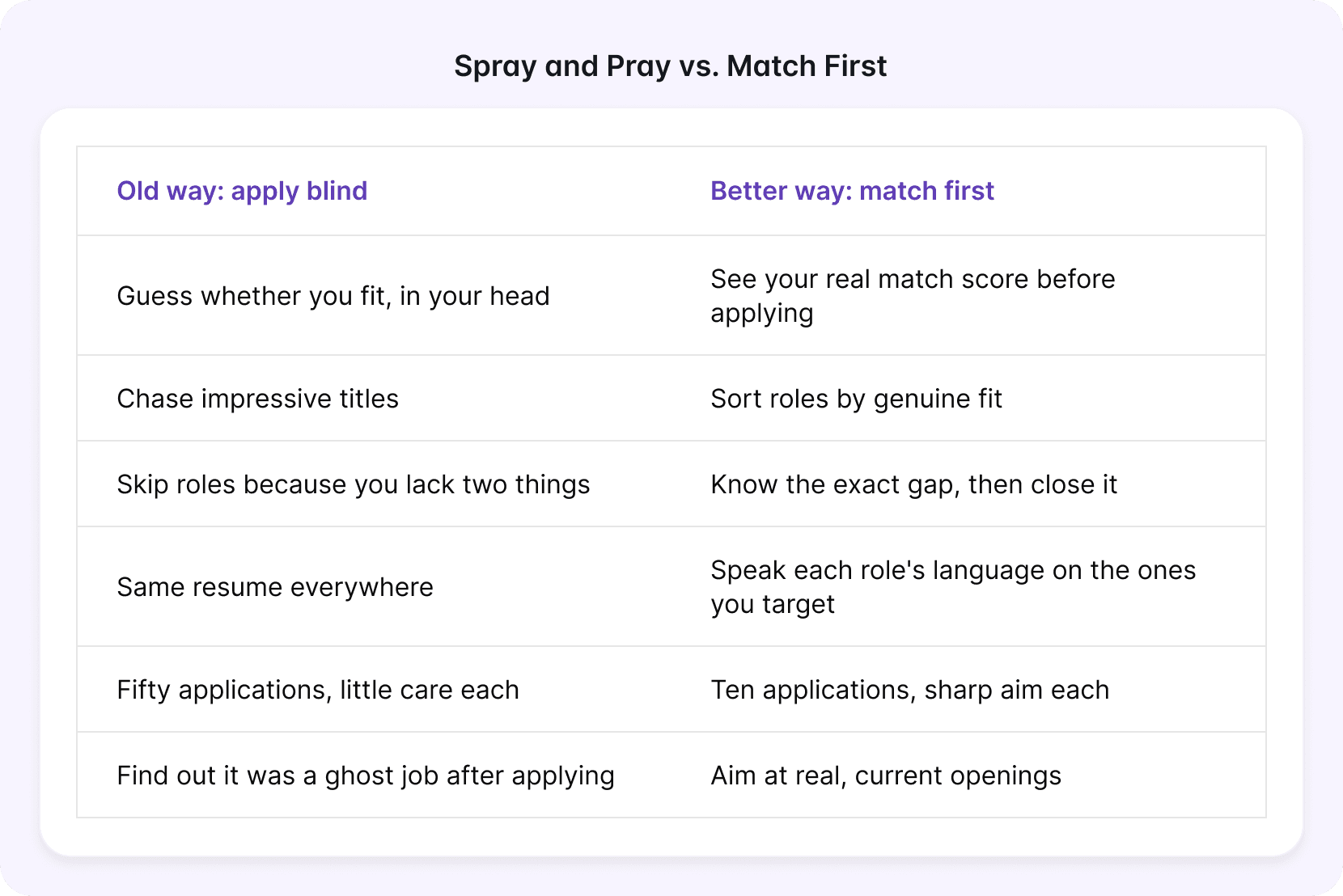
Spray and Pray vs. Match First
| Old way: apply blind | Better way: match first |
| Guess whether you fit, in your head | See your real match score before applying |
| Chase impressive titles | Sort roles by genuine fit |
| Skip roles because you lack two things | Know the exact gap, then close it |
| Same resume everywhere | Speak each role's language on the ones you target |
| Fifty applications, little care each | Ten applications, sharp aim each |
| Find out it was a ghost job after applying | Aim at real, current openings |
How to Stop Guessing
You should not have to wonder whether you fit a job. You can just see it.
Start with your resume itself. MindPal's free AI resume checker reads your resume across six areas: content quality, language and grammar, professional experience, bullet point strength, skills, and personal information. You get a clear score and a specific list of what to fix. On average, people who apply the fixes raise their score by about 42 points, and a resume sitting at 44%, the kind that quietly disappears, often reaches 86%. Your first result is ready in about 30 seconds.
Then let fit lead the way. On the MindPal job board, you upload your resume once and see your match score for every real, current opening, sorted so your strongest fits come first. For each role you can see the specific skills standing between you and a stronger match, so you know exactly what to add instead of guessing. If a gap is real and you want to rebuild from a cleaner base, the resume builder gives you a professional structure to start from, and our bullet point guide shows you how to turn plain duties into the kind of results that get a reply. When you are running a full search and want unlimited checks and deeper tools, you can compare candidate plans here. Start free. Upgrade only if it earns it.
Before You Apply to the Next One
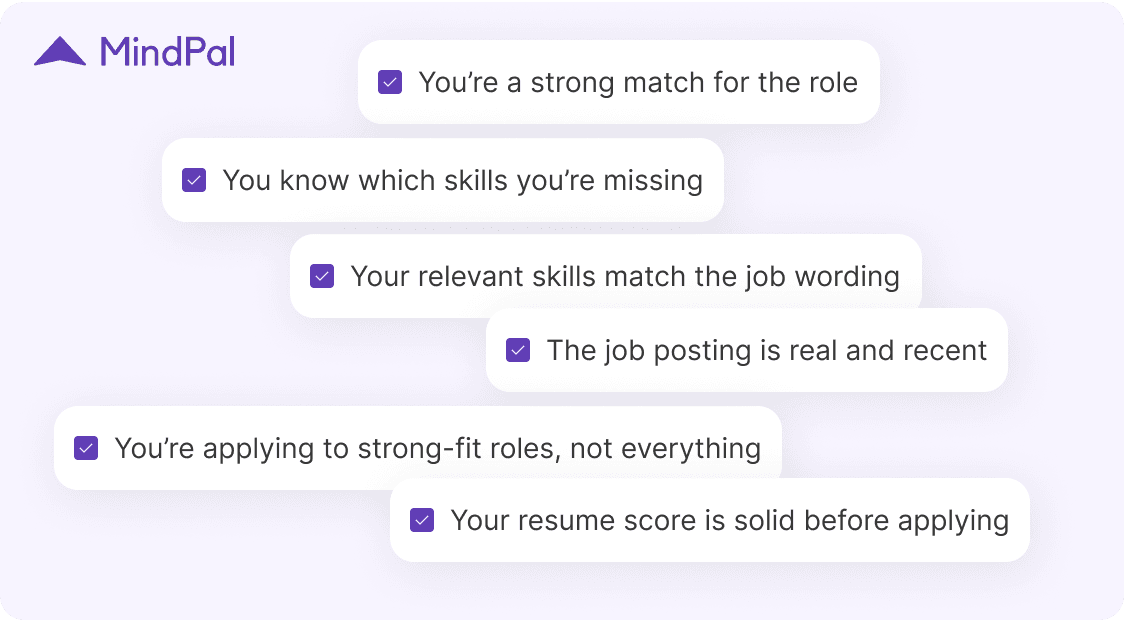
Run through this quick list:
☐ You have seen your actual match to this role, not just a hunch that you fit
☐ This role is one of your stronger matches, not just the most impressive title
☐ You know the specific skills or requirements you are light on for this job
☐ Any skill you genuinely have is written down, in the words the role uses
☐ The posting looks real and recent, not one that has been open for months
☐ You are applying to a focused set of strong-fit roles, not blasting fifty
☐ Your resume score is solid before you send, not something you will check later
The Questions You Are Quietly Asking
How do I know if a job matches my resume?
Do not judge it in your head. Compare your resume against the specific role and look for overlap in skills, job title, and the top requirements. The clearest way is to see a match score for the role before you apply, along with the specific skills you are missing, so fit becomes a number you can act on rather than a guess.
Should I apply if I do not meet all the requirements?
Usually, yes. Most postings list an ideal candidate, not a strict checklist, and strong applicants routinely get hired while missing a few items. A helpful rule of thumb: if you clearly meet most of the core requirements, apply. Skipping every role where you lack one or two things is one of the most common ways good candidates take themselves out of the running.
How many qualifications do I really need to have?
There is no magic percentage, but you do not need 100%. If you meet the core, must-have requirements and are only light on a few nice-to-haves, you are a legitimate candidate. Focus on whether you can do the actual job, not on whether you tick every bullet.
Why do I keep getting rejected when I apply to so many jobs?
Volume is often the problem, not the solution. Blind, high-volume applying spreads your effort thin, sends the same generic resume everywhere, and mixes real openings in with ghost jobs. A smaller number of well-matched, tailored applications consistently beats a flood of generic ones.
Is it worth tailoring my resume for each job?
For the roles you genuinely want, yes. Tailoring to the job description has been linked to meaningfully higher interview rates, and even matching the job title lifts your odds. You do not need to rewrite everything. Match the language of the role and make sure your most relevant experience is easy to see.
How can I find jobs I am actually qualified for?
Let fit filter for you instead of scrolling and guessing. Upload your resume once, see your match to each opening, and start with your strongest fits. It turns a long, blind list into a short, sharp one you can act on with confidence.

Stop Applying in the Dark
If you take one thing from this, let it be this: the exhaustion you have been feeling is not proof you are not good enough. It is what happens when you aim without being able to see the target. You have been playing a guessing game that was always going to wear you down.
You do not have to keep guessing. See your fit. Start with your strongest matches. Close the small, honest gaps. Then apply like someone who already knows they belong in the room, because you will.
See which jobs match your resume on MindPal. Upload once, and let the right roles come to the top.
Updated for the US job market | Category: Job Search, Resume Checker, Career Advice
Related: Resume Checker · Job Board · Resume Builder · Bullet Points Guide · Career Guides
Note: Priya and Devon are representative composites based on common job-search patterns, not specific individuals. Statistics are drawn from recent US job-search research.
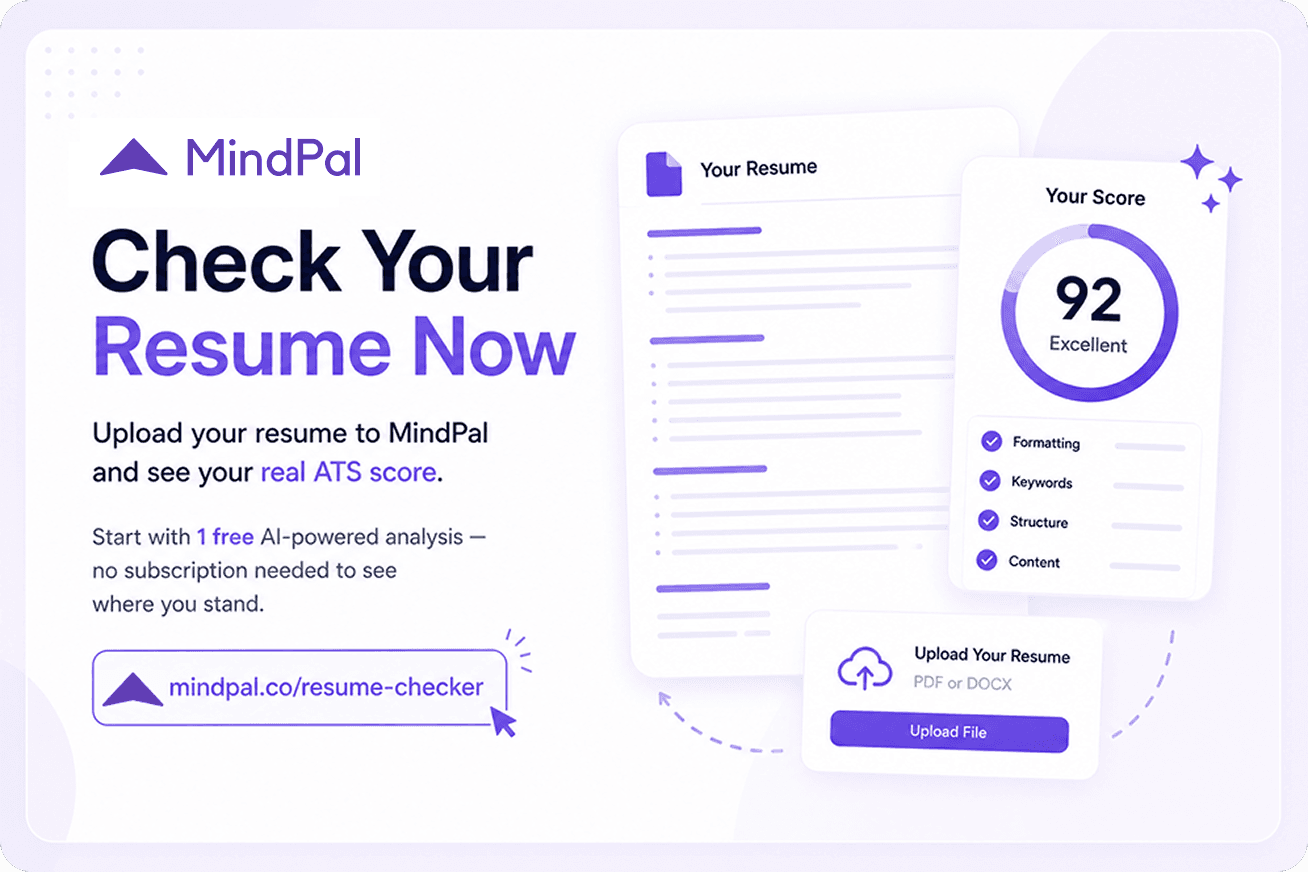
Run a Free Resume Check Before You Apply
Upload your resume to MindPal Resume Checker at mindpal.co/resume-checker. Your first AI analysis is free.
Your resume is private and secure. Start with 1 free AI analysis.
Disclaimer: All product names are property of their respective owners. Informational purposes only.
Olga Nazarenko
UX UI Designer, MindPal.co
Share this blog post via
Read other articles
1 / 0
FOR BUSINESS
Manufacturing for construction
Recruitment
FOR INDIVIDUALS
SOLUTIONS

This site is protected by reCAPTCHA and the Google Privacy Policy and Terms of Service apply.
Copyright © MindPal 2026. All Rights Reserved.