October 27, 2026
Is This Job Real? How to Spot a Ghost Job Before You Apply
16 min read
In this article, you'll discover:
What a ghost job is, in one plain sentence
- Why companies post jobs they are not trying to fill
- 8 red flags that a posting may not be real
- A 5-minute check you can run before you apply
- The difference between a ghost job and a job scam
- Two short stories of people who stopped feeding the black hole
- What US lawmakers are doing about ghost jobs
- Straight answers to the questions people ask most
Quick answer
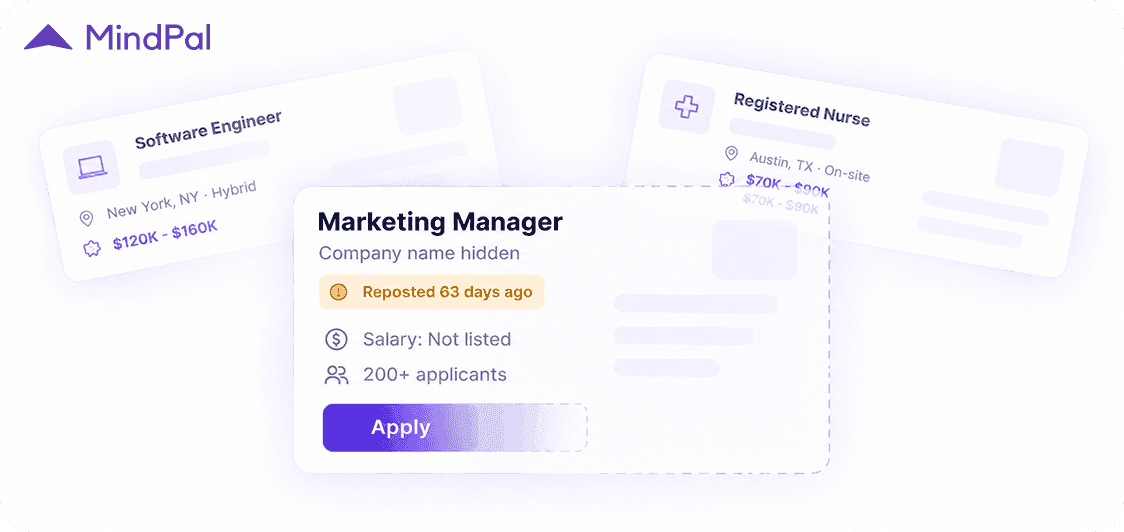
A ghost job is a job posting for a role the company is not actively trying to fill. The position may already be taken, frozen, or never planned at all. You can spot most ghost jobs by checking three things: whether the role is on the company's own careers page, how long it has been posted or reposted, and whether the listing has a real salary range and a specific team. If two of those fail, put your energy somewhere else.
If you have sent out application after application and heard nothing, you have probably wondered if some of those jobs were even real. You are not imagining it. In a recent survey of 1,000 active US job seekers, 67% said they had suspected a posting was fake or misleading.
That suspicion is exhausting. Every application costs you time, hope, and a little confidence. When a role was never going to be filled, the silence was not a verdict on you. It was a dead end you could not see. Here is how to see it.
What Is a Ghost Job?
A ghost job is a listing that looks like a real opening but is not leading to a hire anytime soon. Some are old roles nobody took down. Some are posted "just in case." Some were filled internally before the ad went live.
How common are they? The numbers vary, but they all point the same way:
- About 1 in 5 postings. Greenhouse, a hiring software company, classified roughly 18% to 22% of postings on its platform as ghost jobs in a given quarter.
- 40% of hiring managers. In a ResumeBuilder survey of 1,641 hiring managers, 4 in 10 said their company had posted a fake job listing in the past year, and about 3 in 10 had one live at the time.
One honest note: many of these surveys come from companies that sell hiring tools, so treat the exact figures as directional. The pattern is still clear. A real share of what you see online is not a real opportunity.
Why Do Companies Post Jobs They Are Not Filling?
Knowing the reasons helps you spot the pattern:
- Building a talent pool. Collecting resumes now for a role they might open later.
- Looking like they are growing. Open roles signal health to investors, customers, and competitors.
- Calming the current team. Telling overworked employees that help is "on the way."
- Meeting internal rules. Posting a role publicly even when an internal candidate is already chosen.
- Forgetting to take it down. The role was filled or frozen, and the ad simply stayed up.
None of this is about you, which means you can protect your time without doubting yourself.
8 Red Flags That a Job Posting May Not Be Real
One red flag alone is not proof. Two or three together are a strong signal to move on.
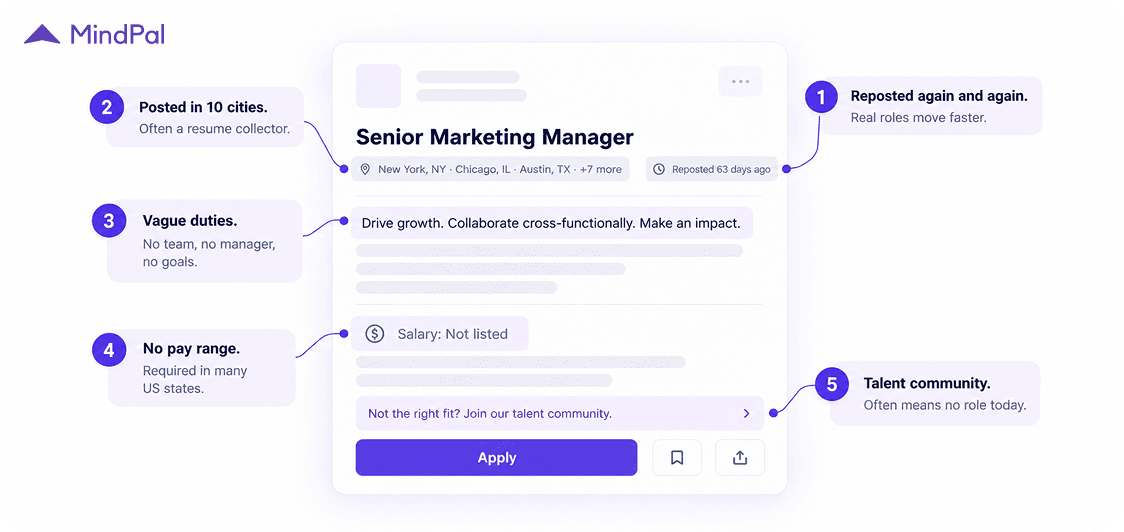
- It has been up for weeks, or keeps getting reposted. On LinkedIn, look for "Reposted" or a posting date of 30+ days. Real, urgent roles usually move faster.
- It is not on the company's own careers page. If you only find it on a job board, that is a warning sign.
- The description is vague. Generic duties, no team name, no manager, no clear goals. Real roles usually describe a real problem someone needs solved. When you find one, here is how to match your resume to a job offer.
- There is no salary range. More than a dozen states and Washington, D.C. now require pay ranges in job postings, including California, Colorado, Illinois, New York, and Washington. A missing range where one is required is a red flag.
- The pay seems too good to be true. In the same US survey, 45% of job seekers named this as a top warning sign, along with typos (52%) and vague company details (52%).
- It talks about "future opportunities." Phrases like "always hiring," "join our talent community," or "for future openings" often mean there is no role today.
- The company is in the news for layoffs or a hiring freeze. A fresh posting next to fresh layoff headlines deserves a second look.
- The same role is posted in many cities at once. One identical listing across 10 locations is often a resume collector, not a seat that needs filling.
How to Check a Job in 5 Minutes
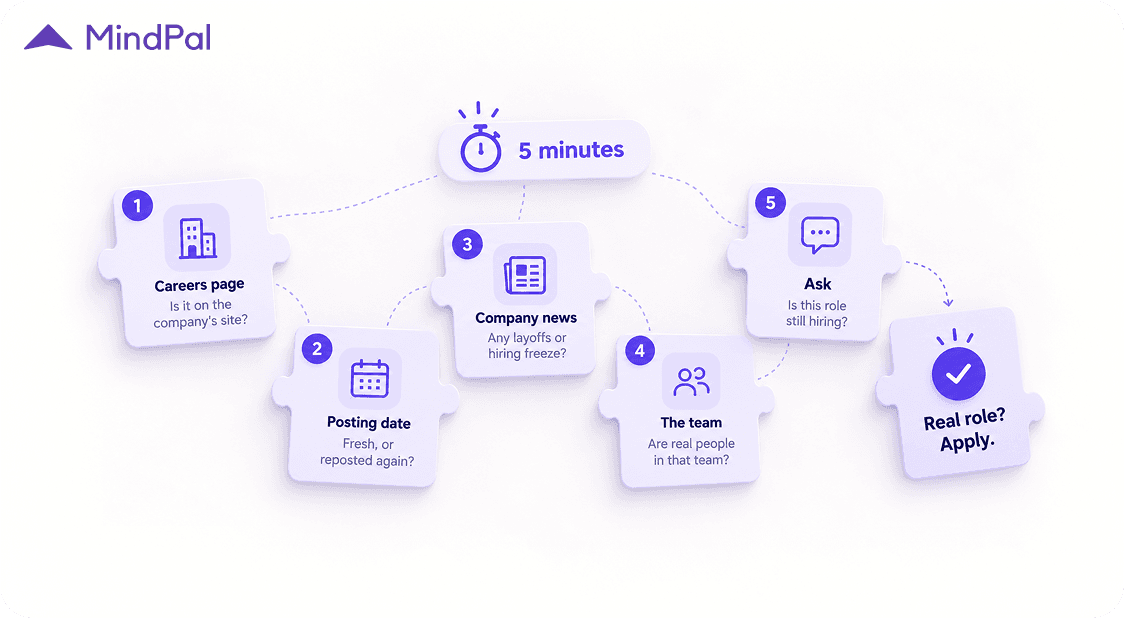
Before you spend an hour tailoring your resume, spend five minutes on this:
- Find it on the company's careers page. Search the exact title. If it is there and recently dated, that is a good sign.
- Check the date. Look at when it was first posted and whether it has been reposted. Fresh is better.
- Search the company news. Type the company name plus "layoffs" or "hiring freeze."
- Look for the team on LinkedIn. Are there people in that department? Did anyone join recently in a similar role?
- Ask. Send a short note to a recruiter or someone on the team: "Hi, I'm interested in the [role] posting. Is it still actively hiring?" A real role usually gets a real answer.
If the job passes, apply with confidence. If it fails two or more checks, save it and move on. You are not giving up. You are choosing where your effort counts.
Ghost Job vs. Job Scam: Know the Difference
They overlap, but they are not the same thing. A ghost job wastes your time. A scam is after your money or your identity.
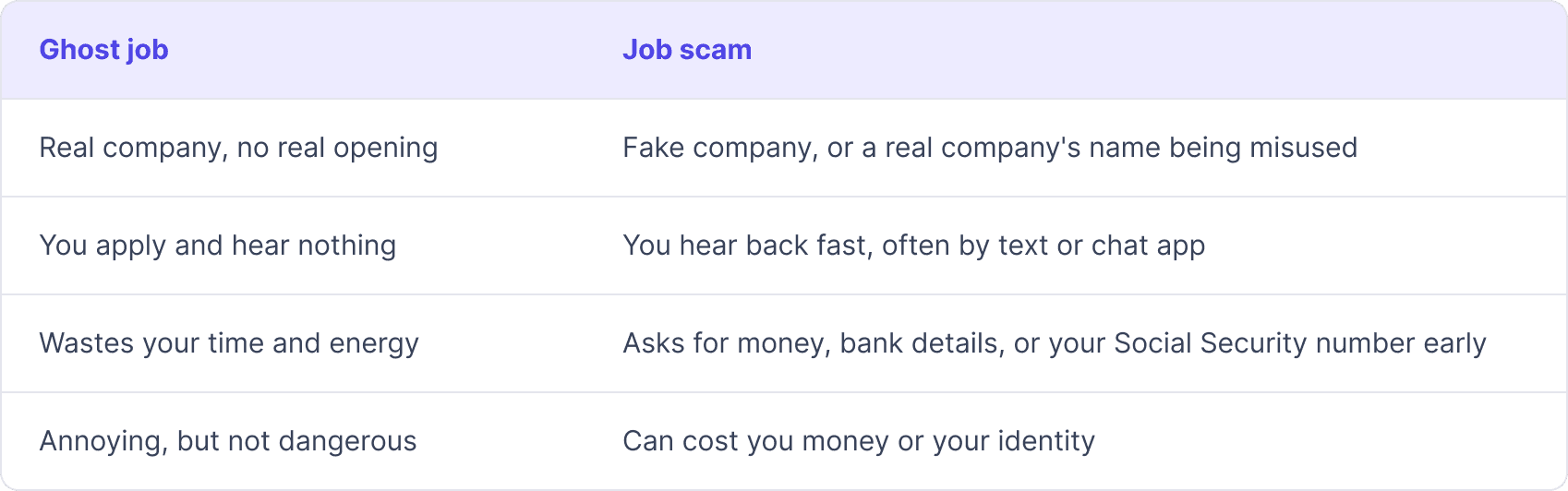
If anyone asks you to pay for training, equipment, or a "background check" before an offer, stop. That is not a ghost job. That is a scam, and you can report it to the Federal Trade Commission at ReportFraud.ftc.gov.
Two Short Stories
Consider Kayla, who thought she was the problem.
Kayla was a marketing manager in Austin who had been laid off after six years. She applied to 40 roles in a month and got two automated rejections and a lot of silence. Then she went back through her list. Eleven of the roles had been reposted at least twice. Six were not on the company's careers page at all. One company had announced layoffs the same week she applied.
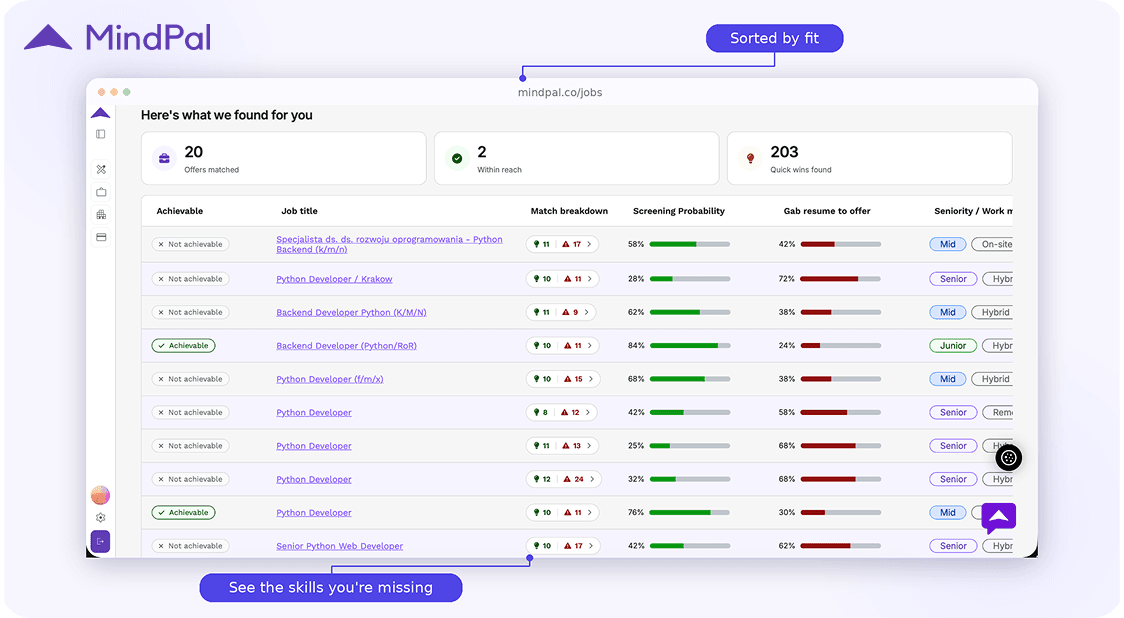
She stopped scrolling the big boards and started with live openings instead. She uploaded her resume to a job board that showed her match for every current role, sorted by fit, and spent her week on the top eight. Three weeks later she had two first-round interviews. She did not need more applications. She needed real ones.
Then there is Andre, who almost spent his Saturday on a ghost.
Andre worked in IT support in Columbus and found what looked like a perfect systems administrator posting. Before rewriting his resume for it, he ran the five-minute check. The listing had been up for 63 days, the same ad appeared in nine cities, and there was no salary range. He sent one short message to a recruiter at the company. The answer came back the next day: the role was "on hold."
So he used the Saturday differently. He ran his resume through a checker, saw that his bullets read like a list of duties, and rewrote four of them into results with real numbers, like "cut ticket response time by 30%." Then he applied to two systems roles that were posted that week and had named hiring managers. One of them called him back.

What US Lawmakers Are Doing About Ghost Jobs
Ghost jobs have caught lawmakers' attention, and some states are moving to limit them.
- New York passed a bill (S8877) through both houses of the state legislature. It would require employers with 100 or more employees to say in each posting whether they plan to fill the role within 90 days, later, or are only collecting resumes, and to take ads down within two weeks of filling them. Fines would start at $2,500 per posting. At the time of writing, it is waiting for the governor's decision and is not yet law.
- New Jersey and California have similar bills moving through their legislatures. Neither has been enacted yet.
- At the federal level, there is no ghost job law, though members of Congress have asked federal agencies to look into the practice.
Until then, your best protection is the five-minute check.
Put Your Energy Into Real Openings
Hiring has become a numbers game that nobody is winning. Applications per job more than doubled between 2022 and 2025 (up 111%), while the number of recruiters fell by 56%. In a recent Greenhouse survey, 81% of job seekers said they had been rejected in the past year without hearing from anyone. When the pile is that big, the smartest move is not to apply more. It is to apply where it counts.
Start with fit. On the MindPal job board, you upload your resume once and see your match score for every current opening, sorted so your strongest fits rise to the top. For each role, you can see the specific skills standing between you and a closer match, so you know which applications are worth your best effort. If you want to learn how that number works, our guide on finding jobs that match your resume walks through it.
Then make sure your resume is ready. MindPal's free AI resume checker scores your resume across six areas: content quality, language and grammar, professional experience, bullet point strength, skills, and personal information. Your first result is ready in about 30 seconds after you create your free account, and people who apply the fixes raise their score by about 42 points on average. Need to turn duties into results? Our bullet point guide shows you how, and the resume builder gives you a clean structure to work in. If you are running a full search, you can compare candidate plans here. Start free. Upgrade only if it earns it.
Your Ghost Job Checklist
Before you apply, check that:
- The role is on the company's own careers page
- It was posted recently and has not been reposted again and again
- The listing names a team, a manager, or a clear goal
- There is a salary range, especially in a state that requires one
- The company is not in the news for layoffs or a hiring freeze
- The same ad is not copied across many cities
- Nobody is asking you for money or personal financial details
- It is one of your stronger matches, not just the most impressive title
The Questions People Ask About Ghost Jobs
What is a ghost job?
A ghost job is a job posting for a role the company is not actively trying to fill. The position may already be filled, frozen, or only posted to collect resumes for later.
How common are ghost jobs?
Estimates vary, but Greenhouse classified about 1 in 5 postings on its platform as ghost jobs in a given quarter, and 40% of hiring managers in one survey said their company had posted a fake listing in the past year.
How do I know if a job posting is real?
Check that the role appears on the company'sa own careers page, that it was posted recently, and that it includes a salary range and a specific team. Then search the company's news for layoffs. If you are still unsure, send a short message to a recruiter and ask if the role is actively hiring.
Why do companies post ghost jobs?
To collect resumes for later, signal growth, reassure overworked teams, meet internal posting rules, or because nobody removed a filled role.
Are ghost jobs illegal in the US?
Not yet at the federal level, and no US state has a ghost job law in force. New York's legislature has passed a bill that would require hiring timelines in postings and fine employers who do not comply, and New Jersey and California are considering similar bills.
What is the difference between a ghost job and a job scam?
A ghost job is a real company with no real opening, so it wastes your time. A scam pretends to be a job so it can take your money or personal information. If anyone asks you to pay or share bank details before an offer, stop and report it to the FTC.
The Silence Was Not About You
If you take one thing from this guide, let it be this: some of the silence you have been hearing was never about you. It was about jobs that were never really open.
You cannot fix a broken posting, but you can stop feeding it your best hours. Check before you apply, start with roles you truly match, and give those your full effort.
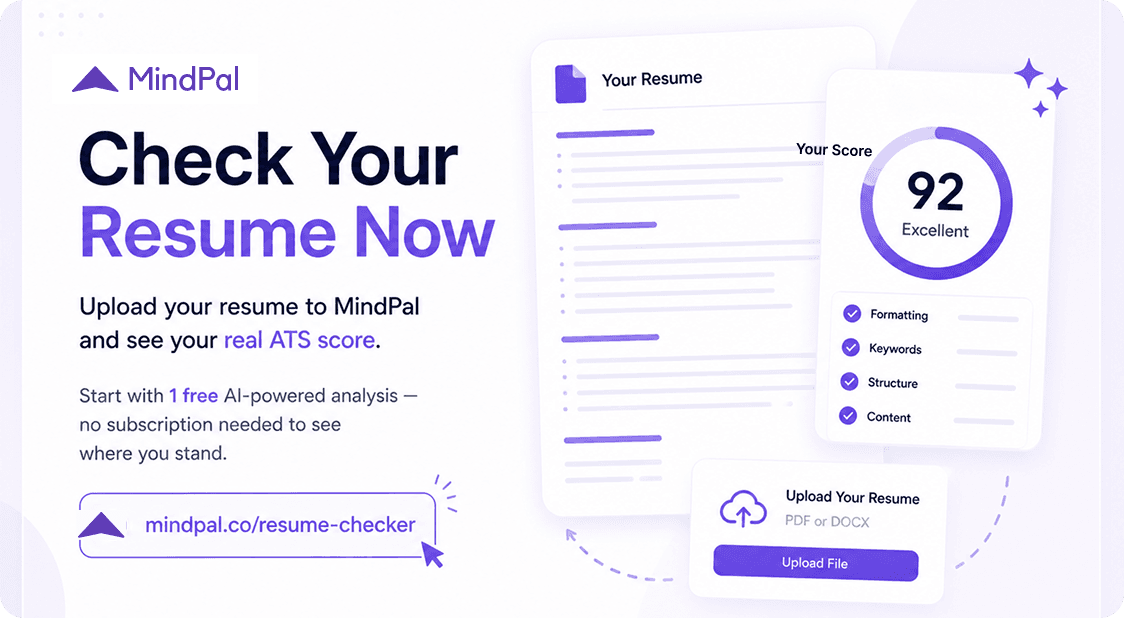
See your match for real, current openings on MindPal. Upload your resume once and start with your strongest fits.
Related: Job Board · Resume Checker · Resume Builder · Bullet Points Guide · Why You Get No Response · All Career Guides
Kayla and Andre are representative composites based on common job-search patterns, not specific individuals. Statistics are drawn from recent US job-search research: Resume Genius Job Seeker Insights Report (1,000 US job seekers), Greenhouse State of Job Hunting report and job seeker survey, ResumeBuilder survey of 1,641 hiring managers, and reporting by SHRM and Fortune. Legislative status checked at the time of writing.
Olga Nazarenko,
UX UI Designer,
MindPal.co
Share this blog post via
Read other articles
1 / 0
FOR BUSINESS
Manufacturing for construction
Recruitment
FOR INDIVIDUALS
SOLUTIONS
This site is protected by reCAPTCHA and the Google Privacy Policy and Terms of Service apply.
Copyright © MindPal 2026. All Rights Reserved.