November 24, 2026
Is ChatGPT a Good Resume Checker? 7 Problems to Know Before You Rely on It
13 min read
In this article, you'll discover:
Why ChatGPT isn't a reliable resume checker on its own, even though it can read your resume and a job description
- Seven specific problems, from invented achievements to feedback that changes from one chat to the next
- What weak AI resume feedback looks like, with examples
- How a ChatGPT review compares with a structured resume checker for the same resume
What to look for in a tool that tells you what to fix for the job you want
Quick answer
Not on its own. ChatGPT can read your resume, compare it with a job description you paste in and polish your sentences. But it's a general-purpose assistant, not a resume review tool. It has no fixed criteria, it can be too agreeable, it can invent results you never had, and it leaves all the organizing to you. Those gaps matter when the document is your first impression with an employer.
Plenty of people try it anyway. In a Greenhouse survey published in October 2026, 77% of US job seekers said they had used AI in their search in the past year. If you're one of them, here's what to watch for.
What ChatGPT can do, and why that isn't the same as checking a resume
ChatGPT handles text well. It can fix grammar, shorten long bullets, explain job-posting jargon and list requirements from a posting that your resume doesn't mention, if you ask.
Checking a resume is a different job. It means applying the same criteria every time, deciding which issues matter most, tying each issue to the role you want and tracking what changed. That's where a chatbot starts to fall short.
7 problems with using ChatGPT as a resume checker
1. It can invent achievements and skills
OpenAI's own help center says ChatGPT "might give you incorrect or misleading information" and "can even make up things like quotes or citations." On a resume, that shows up as numbers, tools or results you never gave it.
Illustrative example (not a real user's resume):
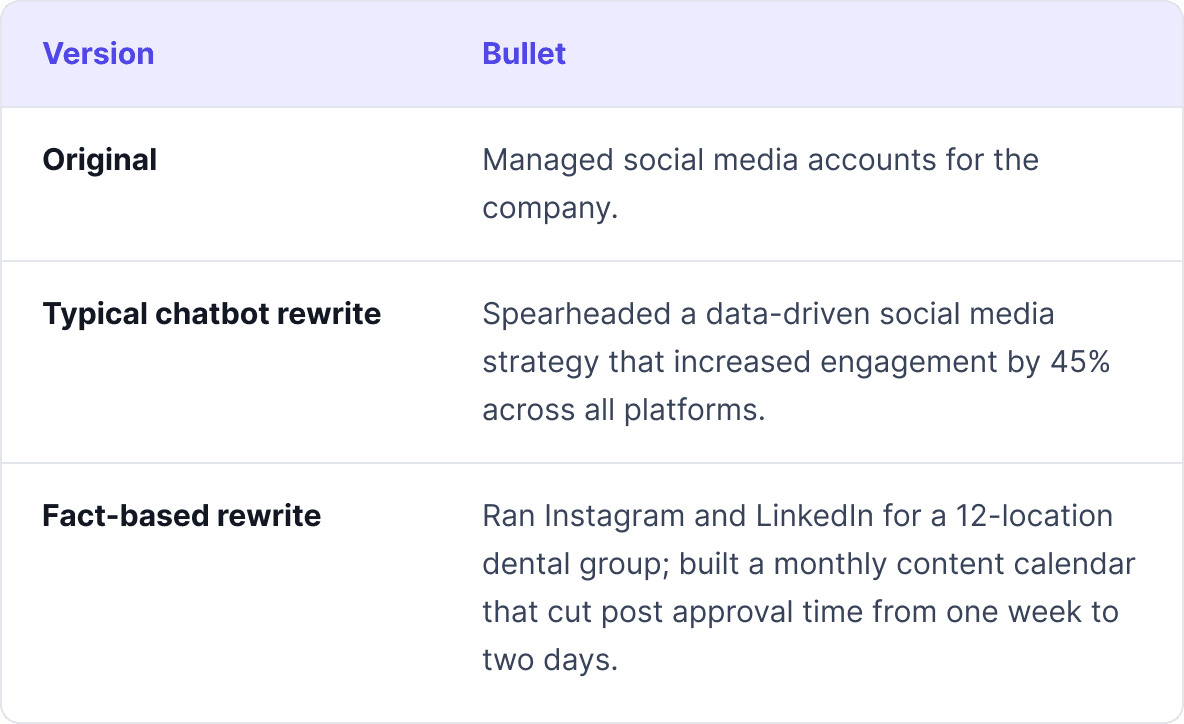
The 45% sounds impressive, but the candidate never reported it. If a hiring manager asks about it, there's no truthful answer. Adding things that aren't true is already a common shortcut: in the same Greenhouse survey, 62% of US job seekers had tried tactics to get past automated screening, and 40% of them added skills or keywords they don't have. A chatbot makes that shortcut easier to take without noticing.
2. It can tell you what you want to hear
In April 2025, OpenAI rolled back a ChatGPT update because the model had become, in the company's words, "overly flattering or agreeable." OpenAI reverted the change, but the episode shows how a general assistant is tuned: to be helpful and pleasant in conversation. A resume review needs the opposite instinct. "Your resume looks strong!" is encouraging, but it isn't a diagnosis.
3. There's no fixed standard
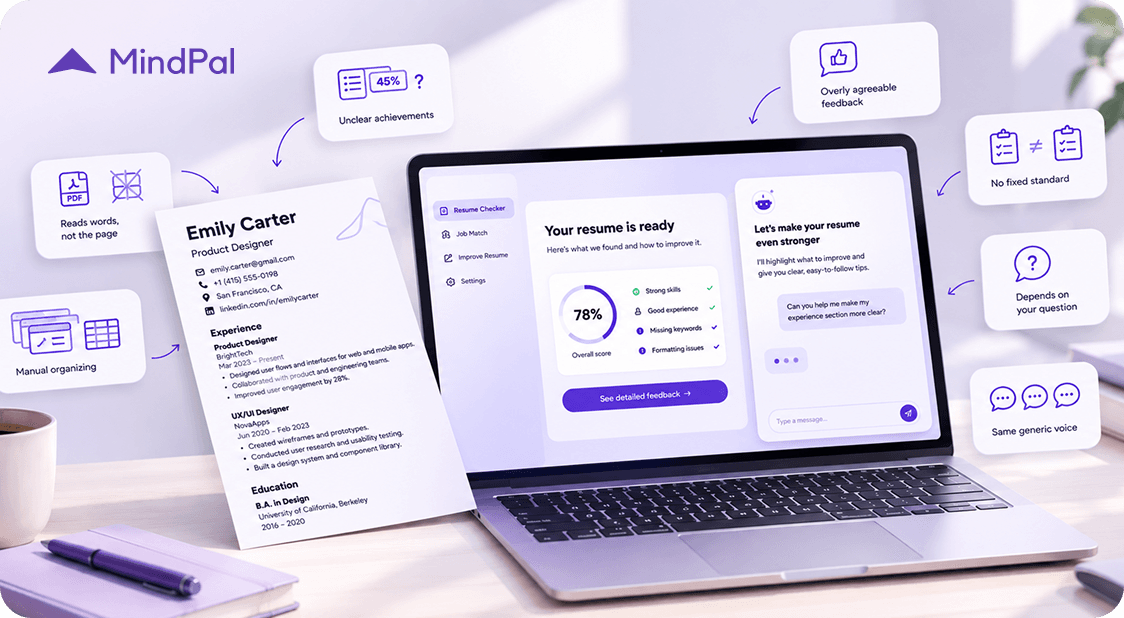
ChatGPT doesn't use a resume checklist unless you write one. Each answer is generated fresh, so the same resume reviewed in two chats can come back with different "top issues" in a different order. That makes it hard to know what to fix first, and hard to tell whether a new version of your resume is better or the conversation just went differently.
4. The review is only as good as your question
"Is my resume good?" gets general advice: add numbers, use action verbs, keep it to one page. A useful review requires you to paste the posting, know which questions to ask and spot what the answer missed. In other words, you need to think like a recruiter to get recruiter-quality feedback.
5. It reads the words, not the page
OpenAI's File uploads FAQ says that for PDFs with text and images, only the text is analyzed, and image-only PDFs aren't supported. A review of your uploaded PDF focuses on the words. It won't reliably tell you how the page looks, and it can't show you how a specific employer's system reads your file.
6. It pushes everyone toward the same voice
"Spearheaded," "leveraged" and "results-driven professional" turn up again and again in AI-assisted resumes. Job seekers have noticed: in the Greenhouse survey, 60% of US respondents had changed or considered changing how they write so their applications wouldn't read as AI-generated, and 39% had already rewritten an application for that reason. Our guide on using AI to improve your resume without getting flagged covers how to fix that.
7. You do all the organizing
Every suggestion has to be copied back into your resume by hand and checked. Every job has to be found, copied and pasted. If you're comparing 10 or 20 openings, you're also keeping notes on which roles fit best and which gaps keep repeating. That's the part many people struggle with already: in a Resume Genius survey of 1,000 US job seekers (April 2026), 41% said tailoring a resume to the job was the hardest part of updating it.
Weak vs. useful AI resume feedback
The examples below are illustrative, written for a fictional candidate (Maya, introduced in the next section). They aren't output from any particular tool.
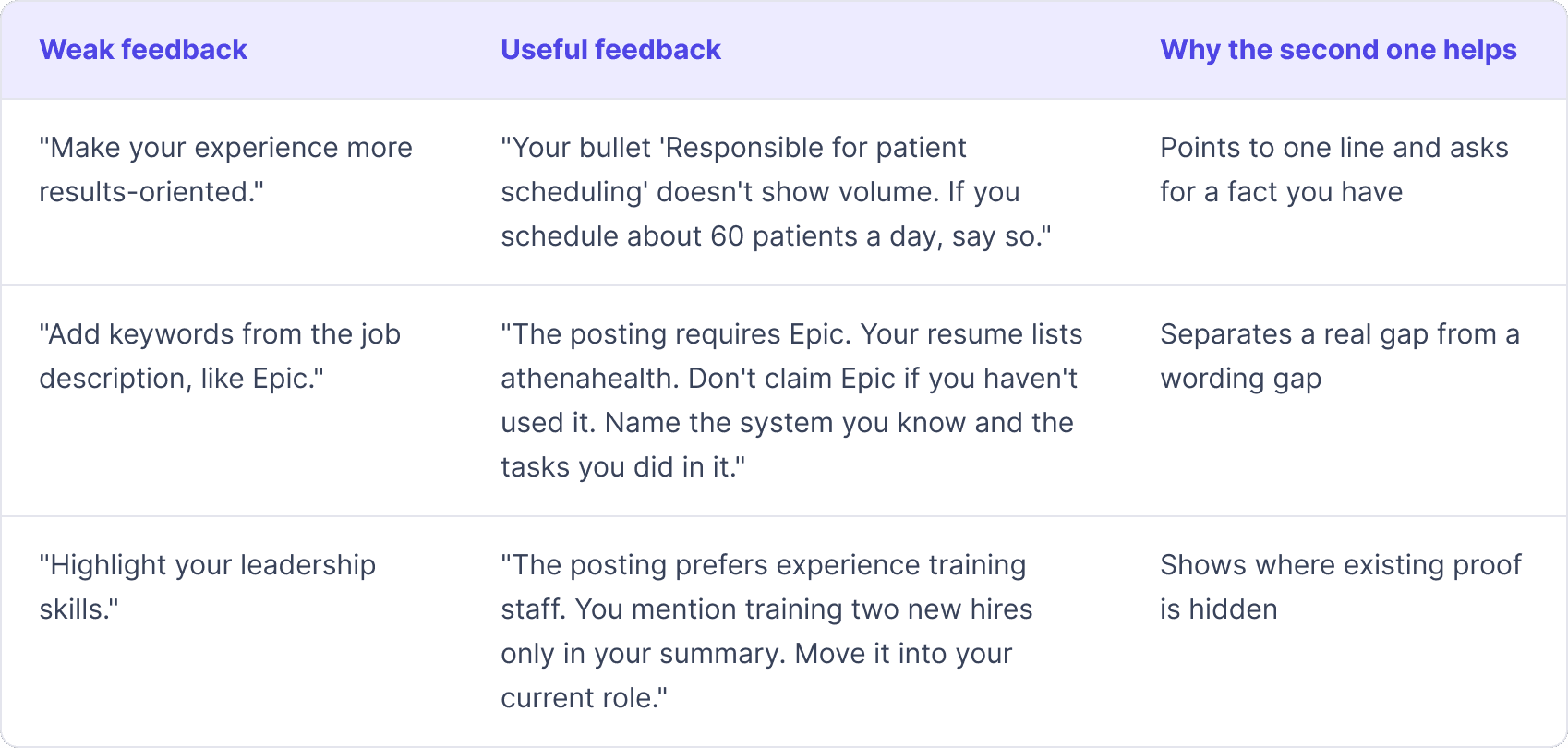
Before you act on any suggestion, check:
- Is it tied to a specific line in your resume or the job description?
- Can you verify it? If a number, tool or title appears that you didn't provide, delete it.
- Is it prioritized? Fifteen equal suggestions are harder to act on than three ranked ones.
- Could you explain it in an interview?
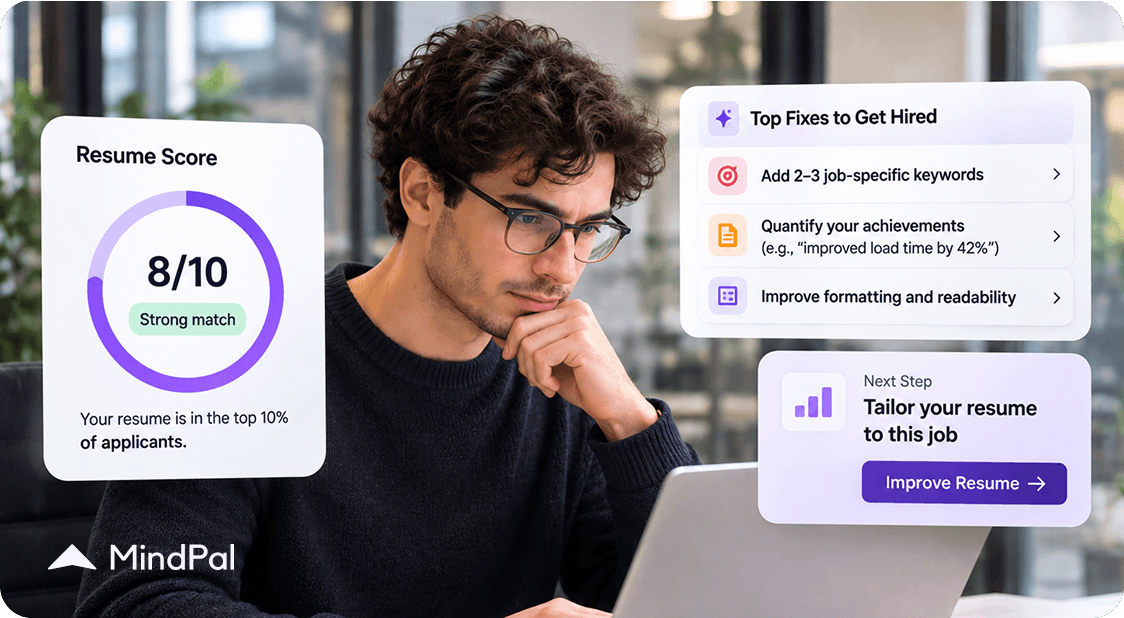
Same resume, two workflows: ChatGPT vs. MindPal Resume Checker
Here's one fictional job seeker and two ways she could review her resume. This is an illustrative workflow comparison, not a test. It describes what each process involves. It doesn't report results, scores or timings from either tool.
The candidate (fictional): Maya is a medical front desk coordinator in Phoenix with four years at a dermatology practice. Her resume says she schedules patients, verifies insurance, uses athenahealth and has trained two new hires.
The job (fictional): Patient Access Supervisor at a hospital outpatient center. Required: three or more years in patient registration or scheduling, insurance verification and prior authorization, Epic experience. Preferred: experience training or supervising staff, bilingual English and Spanish.
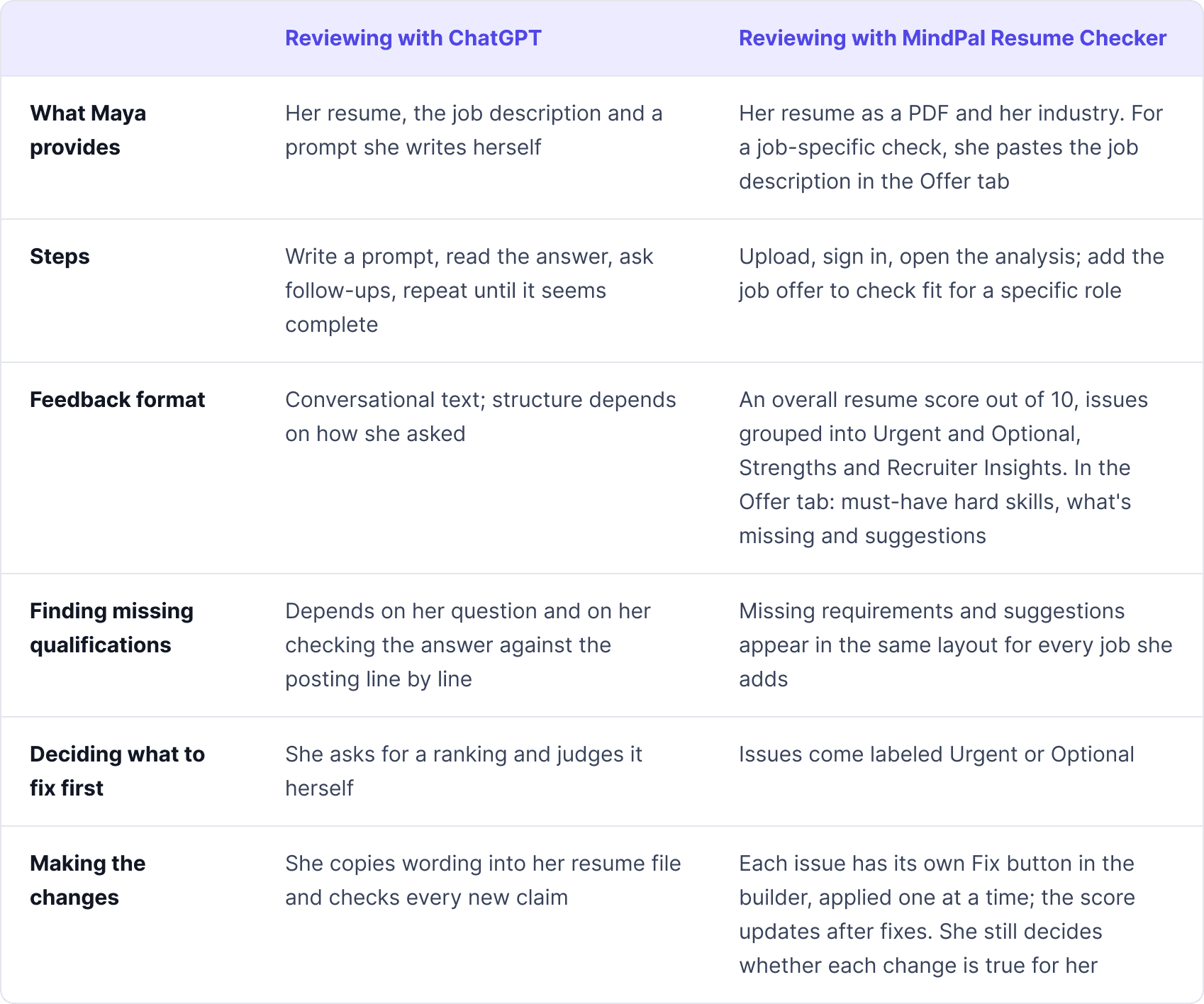
Neither tool can close the Epic gap for her. If she hasn't used Epic, the truthful move is to show her athenahealth experience clearly and apply if she meets most of the other requirements.
What changes with 10 to 20 job openings
With ChatGPT, Maya has to find every posting, paste each one in, ask for a comparison, check the summary against the original text and track the results herself, usually in a spreadsheet.
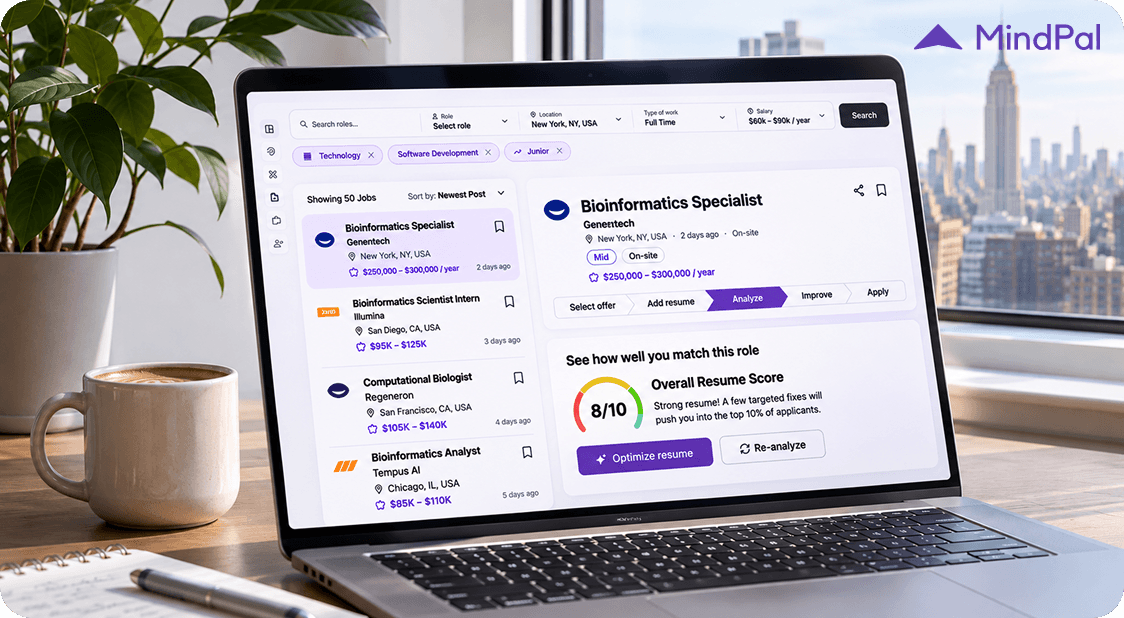
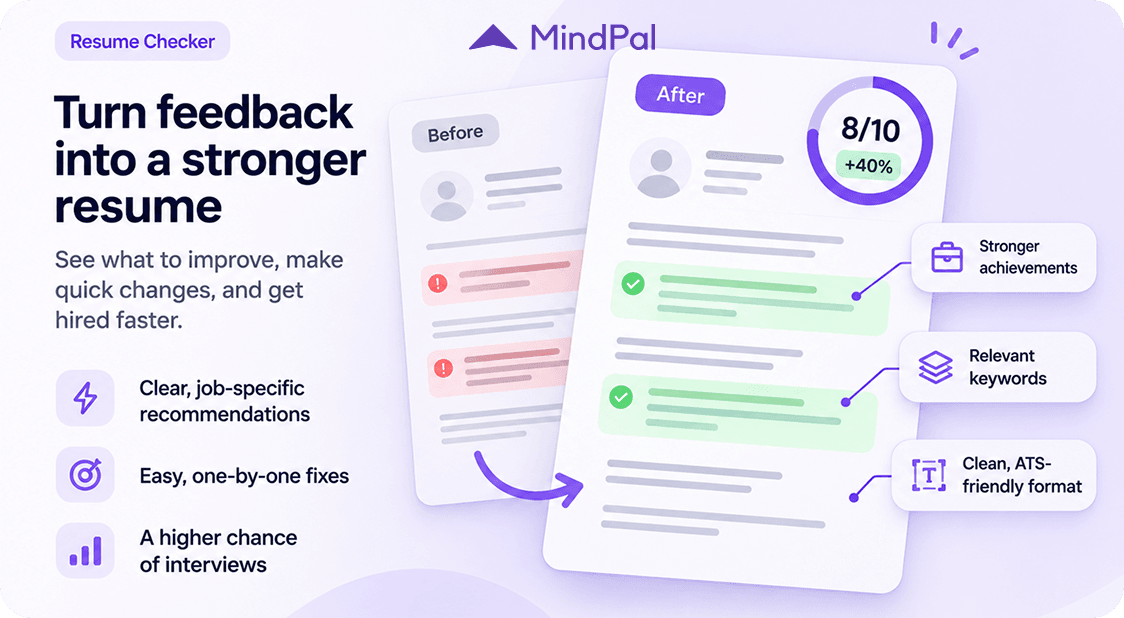
With MindPal Multi-Job Matching, she chooses her resume and sets a scan size between 5 and 100 openings from the MindPal job board. The results show a match breakdown for each offer (resume readiness, quick wins and missing elements) and the gap to each role. She picks a job, selects "Improve this resume" and applies on the employer's site.
One limitation to know: the scan covers jobs listed on MindPal's job board, and coverage varies by field and location. A posting found elsewhere can still be checked on its own in the Offer tab.
What to look for in a Resume Checker
If ChatGPT alone isn't enough, look for a tool that does the parts a chat window leaves to you:
- The same criteria every time, so a change in the result reflects a change in your resume
- Clear priorities, so you know what's urgent and what's optional
- Job-specific gaps, tied to the posting you're applying for
- Fixes you apply one at a time, so you can confirm each change is true
- A way to compare many openings, without copying each posting by hand
Is tailoring worth it? Data from Huntr, a job-search platform and a MindPal competitor, showed tailored resumes led to interviews in 4.23% of applications versus 2.07% for untailored ones, across applications its users logged through Q1 2026. The data is self-reported and shows correlation, not cause. No tool can promise interviews, but a focused, truthful resume gives you a better starting point.
Frequently asked questions
Is ChatGPT a good resume checker?
Not on its own. ChatGPT can compare your resume with a job description and improve wording, but it has no fixed review criteria, can be overly agreeable and may add numbers or skills you never had. You also have to write the prompts, rank the feedback and track every job yourself. Use a structured resume checker for the review and verify every suggestion.
Is it safe to paste my resume into ChatGPT?
Be careful. OpenAI says ChatGPT improves by training on conversations unless you turn that off. Remove your street address, phone number and personal email first, and turn off "Improve the model for everyone" in Settings > Data Controls, or use a Temporary Chat, which OpenAI says isn't used for training and is deleted within 30 days.
Can ChatGPT tell if my resume will get past applicant tracking systems?
No. ChatGPT can't see how a particular employer's system reads your file, and for uploaded PDFs it analyzes the text rather than the layout. It can list requirements your resume doesn't mention if you paste the job description. For the file itself, simple formatting, standard section headings and a text-based PDF or Word file are the safest choices.
What should a good resume checker tell you?
A good resume checker tells you what to fix and in what order. It should point to the specific line each issue refers to, explain why it matters and show what's missing for a particular job. Feedback you can't trace to your resume or the job description isn't worth acting on.
AI resume checker vs. human review: which is better?
They do different jobs. A structured AI resume checker gives fast, organized feedback you can act on for every application. A human reviewer, such as a mentor, career coach or college career center, brings judgment about your industry and how to tell your story. Many job seekers use a checker for each application and a person for bigger decisions.
ChatGPT is a capable writing assistant, but as a resume checker it leaves too much to chance: invented details, shifting criteria, agreeable answers and a lot of manual work. A resume review should be consistent, specific to the job and built around fixes you can verify.
Your resume works when it fits the job. Check your resume with MindPal to see what's urgent, fix issues one at a time and compare your resume against real openings before you apply.
Olga Nazarenko,
UX UI Designer,
MindPal.co
Share this blog post via
Read other articles
1 / 0
SOLUTIONS
CLIENTS
INSIGHTS
This site is protected by reCAPTCHA and the Google Privacy Policy and Terms of Service apply.
Copyright © MindPal 2026. All Rights Reserved.