October 13, 2026
AI Is Replacing These Jobs: Here's What to Put on Your Resume Instead
15 min read

What you'll learn in this article
You've seen the headlines. AI is automating data entry, writing first drafts, handling customer service tickets, and screening job candidates before a human ever reads a single name. And if you're reading this, you're probably wondering: is my job next?
The honest answer is that some roles are shrinking. But the bigger story is what's opening up and how to position yourself for it before the competition does. This guide will show you which jobs are most affected, what skills to add to your resume right now, and how to reframe your existing experience so it lands in a market that looks very different from three years ago.
In this article:
- Which jobs are most at risk from AI automation
- What new skills to add to your resume right now
- How to reframe your existing experience for the AI era
- Resume tips to pass AI-layered ATS systems
- How to find jobs that actually match your updated profile
AI is not replacing people uniformly. It replaces tasks and if your job is mostly made up of tasks that can be described in a repeatable series of steps, your role is vulnerable. The clearest sign of risk is when your daily work involves processing, formatting, or moving information from one place to another without much interpretation or judgment.
High risk, roles already changing fast: Data entry and processing clerks have seen the most dramatic automation. RPA (Robotic Process Automation) tools combined with AI now handle the bulk of what these roles did. Basic copywriters producing templated content, product descriptions, ad variations, email drafts are being replaced by generative AI tools that produce similar output at a fraction of the cost. Tier-1 customer support, the kind that answers FAQs and resets passwords, is now largely handled by AI chatbots that manage 60 to 80 percent of first-contact queries. Junior bookkeeping and invoice reconciliation has been absorbed into tools like QuickBooks AI. Administrative scheduling and coordination. Once a full-time role is increasingly managed by AI assistants.
Medium risk, roles changing shape: Recruiters still exist, but the sourcing and screening work has been automated. The human role now starts later in the funnel. Paralegals are seeing AI absorb document review and contract comparison; legal strategy and client relationships remain human. Junior analysts who once spent time producing reports and dashboards now need to interpret them the production part is increasingly automated. Graphic designers doing production work (resizing assets, generating variations, formatting) are being replaced, while art directors and creative leads are not.
Lower risk roles with growing demand: Healthcare roles that require physical presence and emotional intelligence nurses, therapists, occupational health workers, care coordinators are structurally protected. Skilled trades (electricians, HVAC technicians, plumbers, construction workers) require hands-on, context-specific judgment that AI cannot replicate remotely. And a new category is growing fast: AI-adjacent roles like prompt engineers, AI trainers, automation consultants, and LLM evaluators that didn't exist five years ago.
What Skills to Add to Your Resume Right Now
When pivoting away from an at-risk role, your resume needs to communicate two things at once: that you understand the AI-driven world, and that you bring the capabilities AI cannot replicate. This combination is exactly what hiring managers are looking for in 2026.
Technical skills worth adding even at a beginner level: Prompt engineering basics are now expected across many roles, not just technical ones. Being able to get structured, useful output from tools like ChatGPT, Claude, or Gemini is a practical skill. No-code automation tools like Zapier, Make (formerly Integromat), and n8n are widely used to replace manual workflows, knowing how to set up an automation is increasingly a standard job skill. Data literacy matters too: being able to read, interpret, and draw conclusions from dashboards in Tableau, Power BI, or Google Looker Studio is expected in most analytical and business roles. Beyond these, list whatever AI tools are directly relevant to your field, Notion AI for knowledge workers, Midjourney or Firefly for creatives, Jasper for marketers, GitHub Copilot for developers.
Human skills that AI cannot replicate frame these explicitly: Cross-functional stakeholder management is one of the most durable skills in a world of automated outputs, because coordinating between competing priorities and personalities is deeply human. Strategic decision-making under ambiguity the ability to make a judgment call when data is incomplete, remains irreplaceable. Customer empathy and complex relationship management, especially in enterprise sales, healthcare, education, and services, requires emotional intelligence that no AI currently matches. Creative direction and taste, knowing what is good, not just what is technically correct is increasingly valuable as AI floods every channel with technically-produced content. Team leadership and organizational culture building are also specifically human skills that grow in importance as automation handles more of the execution layer.
How to Write About AI Skills on Your Resume
The most common mistake people make when adding AI skills to a resume is being vague. A bullet point that says 'familiar with AI tools' or 'experience using AI in daily work' tells a recruiter almost nothing. ATS systems scan for concrete, specific language and vagueness gets filtered out before a human ever reads your resume.
The rule is: name the tool, describe the outcome, and include a number wherever possible.
Strong examples that pass ATS and impress recruiters:
“Reduced report generation time by 60% by implementing AI-assisted data summaries using Power BI and GPT-4”
“Automated the lead qualification workflow using Make.com, eliminating 8 hours of manual work per week for the sales team”
“Directed creative strategy across 6 brand campaigns; used Midjourney and Firefly to reduce asset production time by 70% while maintaining brand consistency”
“Built an AI-assisted content pipeline using Claude and Notion AI, scaling output from 4 to 18 articles per month without additional headcount”
Weak examples that get filtered:
“Experience with AI and automation tools”
“Familiar with ChatGPT and similar platforms”
“Used AI to improve efficiency”
The pattern is the same every time: tool + task + measurable outcome. If you don't have exact numbers, use conservative estimates and frame them as approximations ('approximately 40%' is still more credible than nothing). The combination of specificity and scale is what moves a resume from the filtered pile to the shortlist.

How to Reframe Your Existing Experience
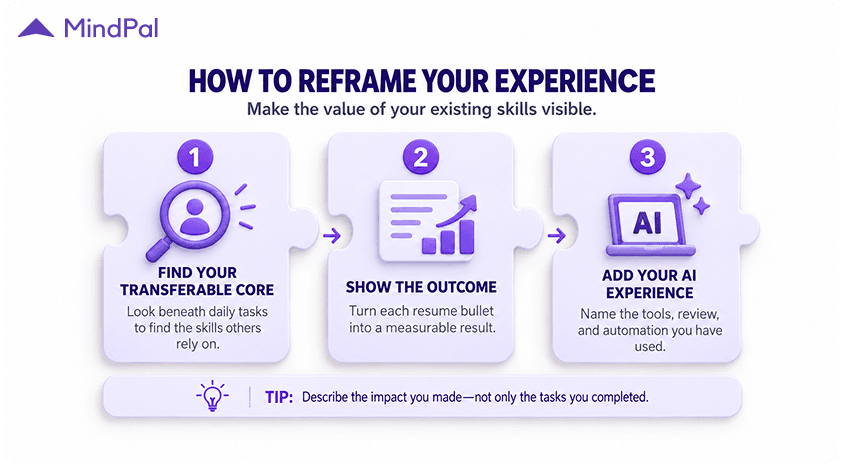
You don't always need new experience. Often what you need is to describe the experience you already have in a way that matches where the market is going. The underlying capabilities in most roles are more durable than the job title and reframing is how you make that visible.
Step 1. Identify the transferable core:
Every role has a layer of capability underneath the task description. A data entry clerk isn't just entering data, they're maintaining data integrity, catching anomalies, and ensuring the accuracy of systems that other people rely on. That's a skill that AI-driven operations still need humans to oversee. A customer support agent isn't just answering tickets, they're reading frustration, de-escalating conflict, and representing a brand under pressure. Ask yourself: what would actually break if I weren't there? That's your transferable core.
Step 2. Shift from task to outcome in every bullet:
Go through each bullet point on your resume and ask: 'So what?' If you 'managed customer support tickets,' the outcome might be '94% CSAT score maintained across 150+ weekly interactions.' If you 'wrote marketing copy,' the outcome might be 'increased email open rate by 23% over six months.' The task describes what you did; the outcome describes what it was worth. Recruiters and ATS systems respond to outcomes.
Step 3. Add the AI layer where honest:
Did you use any AI tools, even informally? Add them. Did you review AI-generated outputs for accuracy before publication? That's AI oversight, a growing and genuinely valued skill. Did you experiment with automation tools outside of work? That counts as self-driven upskilling, which is worth noting. You don't need to have been officially assigned an AI role to claim AI literacy. Most people working in any knowledge role in 2025 and 2026 touched AI tools in some capacity — describe that experience specifically.
Resume Tips for the AI-Era Job Market
The ATS problem hasn't gone away. It has gotten significantly harder. In 2026, most mid-to-large employers run resumes through a two-layer filter: an ATS that scores keyword match, and an AI screening tool that evaluates fit, experience alignment, and red flags before any human reviewer is involved. That means a resume that passes ATS might still be filtered before a recruiter reads it.
Mirror the job description language exactly: This is the single highest-impact change most people can make. If the job description says 'cross-functional collaboration,' use that exact phrase, not 'working across teams' or 'interdepartmental coordination.' The AI screener is matching strings and concepts, and synonym distance matters. Read the job description once for meaning, then read it again specifically to capture the exact vocabulary.
Don't over-format your resume: AI resume parsers struggle with tables, multi-column layouts, text boxes, icons, and infographic-style designs. A resume that looks visually impressive to a human reader may be nearly unreadable to a parser. Stick to single-column layouts, standard system fonts (Inter, Calibri, Arial, Georgia), and clean section headers. Save the visual design for your portfolio.
Your professional summary is now more important than your work history header: The first three to five lines of your resume are processed first by AI screening tools. This means your summary needs to be dense with role-relevant keywords, written in clear declarative language, and specific enough to signal level and specialty. Vague summaries like 'results-oriented professional with strong communication skills' get scored low. A summary like 'Operations Manager with 7 years in logistics automation, experienced in deploying Zapier and Make workflows that reduced manual processing by 40%' scores significantly higher.
Tailor for every application: A generic resume gets a generic result. Each job posting has a different keyword profile and a different scoring weight for different experiences. The effort required to tailor a resume has dropped significantly with AI tools, using MindPal's Resume Checker, you can see your exact match score for a specific job and get a prioritized list of improvements in under a minute.

How to Find Jobs That Match Your Updated Profile
Once your resume reflects where you're going rather than just where you've been, the next step is finding roles that actually fit, not titles that sound familiar from your past.
The most common mistake in a career pivot is searching by old job title. If you were a data entry coordinator and you're now positioning yourself as an automation specialist, searching for 'data entry coordinator' will take you backward. Instead, search by the skills and outcomes you've described on your updated resume. Look for roles that require data accuracy, workflow automation, process optimization, or operational efficiency, the capabilities underneath your former title.
Use a job matching tool that compares your resume directly against job descriptions: Rather than guessing whether you're a good fit, a tool like MindPal's job matcher shows you your actual match score before you apply. This changes your application strategy entirely. Instead of applying broadly and hoping, you apply to roles where you already know your score is competitive and you use the gap analysis to understand exactly what's holding you back from a higher score on the roles that matter most.
Apply strategically, not at volume: The data consistently shows that tailored applications with match scores above 70% significantly outperform mass applications where the match is unclear. Ten applications where you've reviewed your match score and tailored your resume accordingly will generate more interviews than a hundred generic submissions. The spray-and-pray approach was never optimal, and in 2026 with AI screening in place at most companies, it actively hurts your chances. Low-match applications can negatively affect your profile in systems that track engagement.
Is Your Resume Ready for the AI-Era Job Market?
You've identified where you stand. You've updated your skills section. You've reframed your experience to lead with outcomes. Now comes the step most people skip: actually verifying that your resume scores well against the specific jobs you're targeting.
The problem is that you can't see what a recruiter's ATS sees. You don't know which keywords are missing, which sections are weighted most heavily, or whether your formatting is being parsed correctly. You're essentially applying blind.
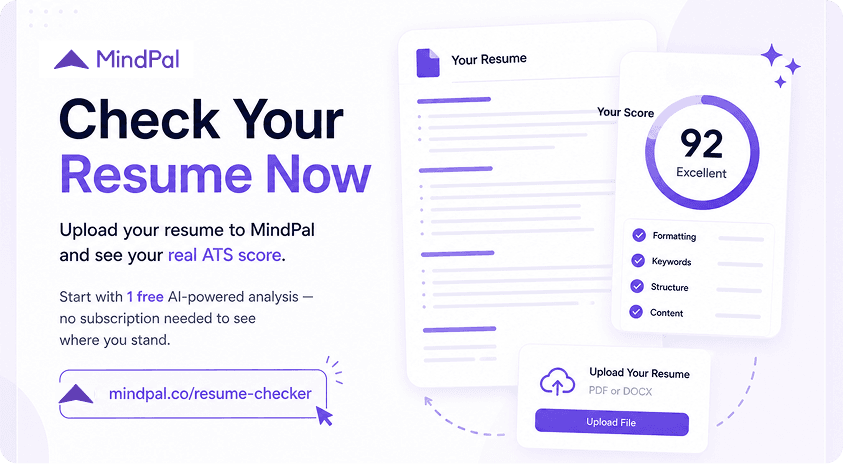
MindPal's Resume Checker fixes that. Upload your resume and a job description, and you get your match score in seconds, along with a breakdown of which keywords are absent, which sections need strengthening, and a prioritized list of specific fixes ranked by their impact on your score. It's the same analysis that an ATS runs on your resume, surfaced before you submit so you can act on it.
It takes under 60 seconds, and it changes the way you approach every application. Instead of wondering whether your resume is good enough, you'll know and you'll know exactly what to do about it.
Olga Nazarenko,
UX UI Designer,
MindPal.co
Share this blog post via
Read other articles
1 / 0
FOR BUSINESS
Manufacturing for construction
Recruitment
FOR INDIVIDUALS
SOLUTIONS
This site is protected by reCAPTCHA and the Google Privacy Policy and Terms of Service apply.
Copyright © MindPal 2026. All Rights Reserved.