October 13, 2026
From Flat Metal Sheets to Faster Quotes: Rethinking the Quoting Process
4 min read
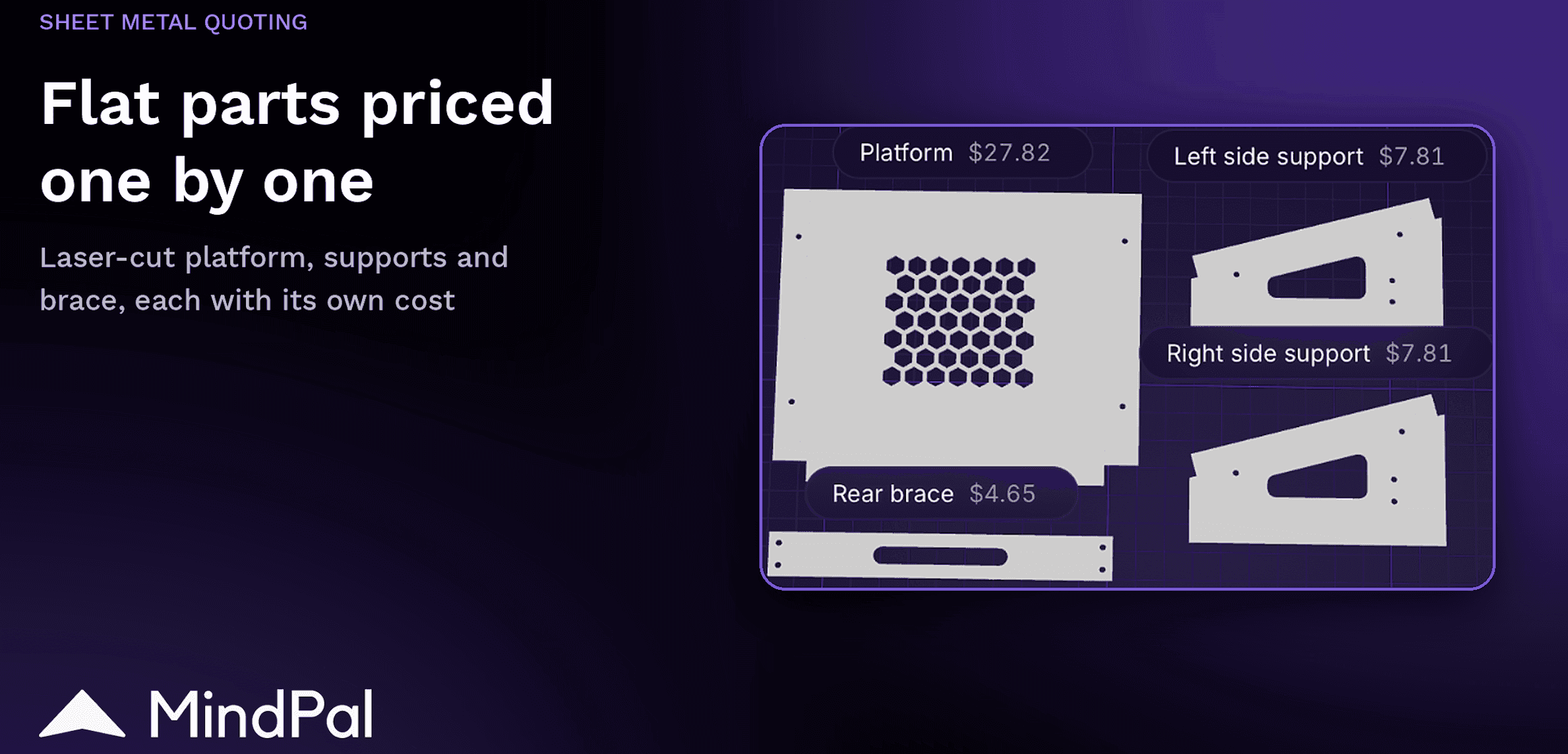
A laser cutter can process a sheet of metal in minutes. Getting a price to the customer, however, can take considerably longer.
Before production begins, manufacturers need to review technical drawings, identify material requirements, estimate cutting and bending time, and account for labor and other costs. When requests arrive in different formats or include multiple components, preparing a reliable quote can become a time-consuming task.
For businesses working with flat metal sheets, the challenge is not always the production itself. Sometimes, it is everything that needs to happen before a job reaches the shop floor.
The hidden work behind a quote
A typical request for quotation (RFQ) may involve several steps. Someone has to interpret the drawing, check dimensions and material specifications, determine which operations are required, and calculate the expected cost.
Some customers provide complete CAD files. Others send technical drawings in PDF or DXF format, leaving the manufacturer to interpret the available information. Projects involving several components can add another layer of work, particularly when each part needs to be estimated separately before calculating the price of the complete assembly.
When these steps rely heavily on manual work and disconnected tools, even a relatively straightforward request can take longer than expected. That can slow down responses to customers and limit the number of quotes a team can handle.
Why software needs to fit the process
Manufacturers are not all working in the same way. A business specializing in laser cutting may have very different quoting requirements from one handling bending, finishing or more complex assemblies.
This is why simply introducing another off-the-shelf tool is not always enough. Software needs to reflect the way a business actually works: the information it receives, the operations it performs, the costs it tracks and the format in which customers expect to receive a quote.
Custom software can help connect these steps. Depending on the requirements, it can support technical file analysis, organize production data, automate calculations and give teams a clearer overview of the costs behind each job. AI can also be incorporated where it offers a practical benefit, such as helping interpret technical information or reducing repetitive manual tasks.
Building software around real manufacturing challenges
At MindPal, the focus is on developing software tailored to specific business processes. In manufacturing, that can mean helping companies simplify quoting workflows, work with technical files and turn production information into structured cost estimates.
The starting point is not necessarily a ready-made product. It is understanding where time is being lost, which decisions require human expertise and which repetitive steps could be handled by software.
For a manufacturer processing a steady stream of sheet metal orders, improving even one part of the quoting process can make day-to-day work easier. The right solution will depend on the company's workflow, the complexity of its jobs and the information available.
The goal is simple: software should adapt to the manufacturing process, not force the business to adapt to the software.
Sources
- FACTUREE – Trends in Sheet Metal Processing
https://www.facturee.de/en/trends-in-sheet-metal-processing-from-ki-to-hybrid-manufacturing-processes/ - Larsen Manufacturing – Latest Trends in Sheet Metal Fabrication
https://larsenmfg.com/latest-trends-in-sheet-metal-fabrication/ - Geomiq – Instant Quoting for Sheet Metal Fabrication
https://memuknews.com/infrastructure/fabrication/geomiq-launches-ai-powered-instant-quoting-for-sheet-metal-fabrication/ - MindPal – Manufacturing Quoting Solution
https://mindpal.co/cnc-rfq
Share this blog post via
Read other articles
1 / 0
FOR BUSINESS
Manufacturing for construction
Recruitment
FOR INDIVIDUALS
SOLUTIONS
This site is protected by reCAPTCHA and the Google Privacy Policy and Terms of Service apply.
Copyright © MindPal 2026. All Rights Reserved.