September 14, 2026
A Practical Guide to Quoting CNC Work Without Leaking Margin
7 min read

Your CNC shop is leaking money every time a quote sits in a spreadsheet.
Not because the parts are hard. Because the quoting process is still stuck in 2012.
Manual estimates and slow turnaround don’t just waste time. They quietly destroy margin, kill win rates, and hand work to shops that answer faster. The numbers from the U.S. precision machining market are ugly once you add them up.
The 5% leak nobody talks about
Process friction and spreadsheet quoting leak about 5% of a shop’s annual operating revenue. On a typical $2.6 million shop that’s $130,000 walking out the door every year. A $10 million shop is looking at more than $500,000.
Across the whole U.S. machine shop sector (roughly 17,100 shops doing $45 billion), that 5% leakage adds up to more than $2.2 billion in lost value. That’s not theoretical. That’s jobs that never got quoted in time, or got quoted wrong.
Speed beats price more often than shops think
Most owners still believe the lowest number wins. Buyers don’t see it that way.
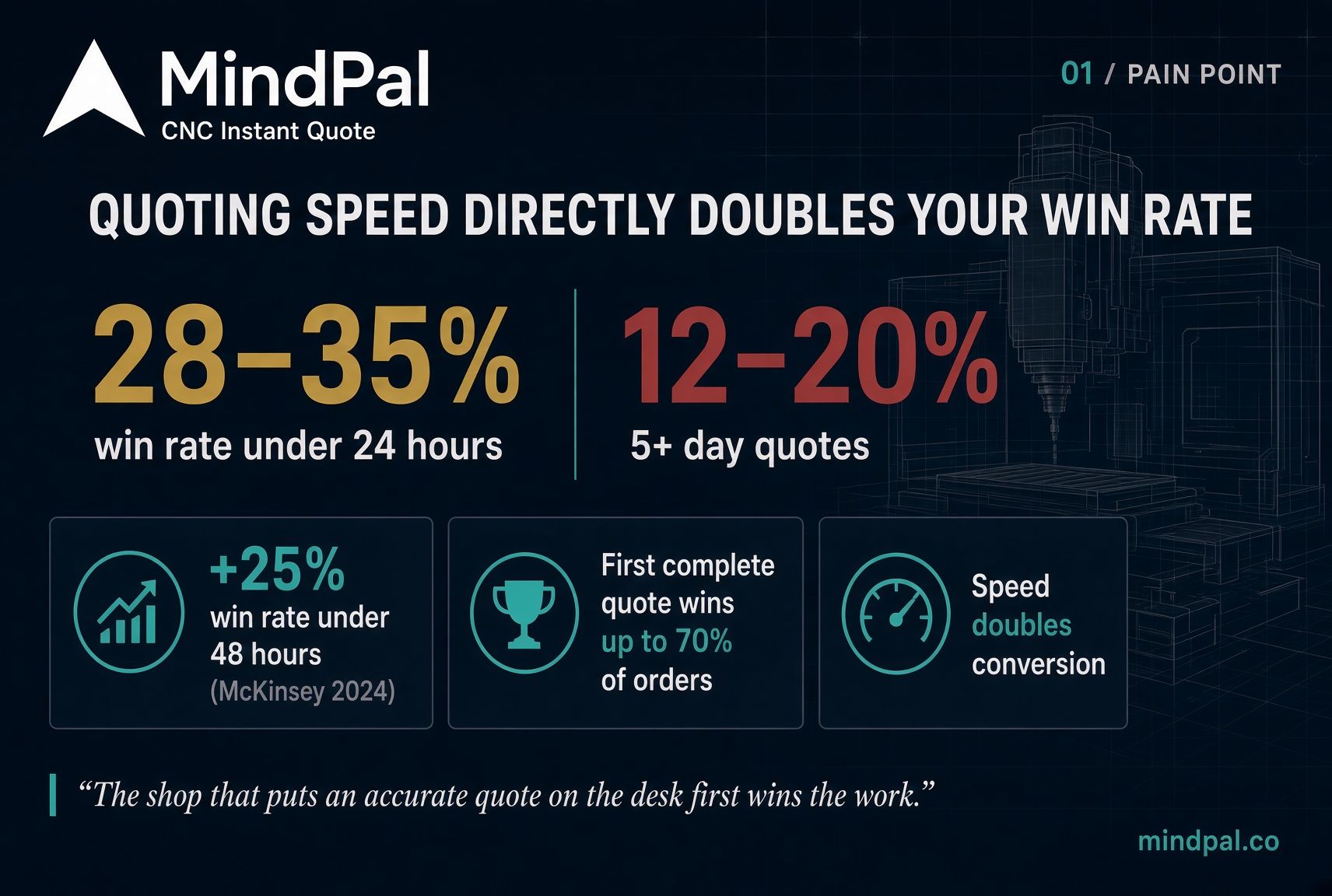
Only 28% of professional buyers list price as the top factor. They care more about delivery time, technical responsiveness, and whether they can trust the schedule. 67% of buyers and engineers expect a complete quote in under 24 hours. 75% make the final call within seven days of sending the RFQ.
The conversion numbers follow that reality:
- Under 24 hours: 28-35% win rate (Top Shops hit 61–70%)
- 24-48 hours: 22-27%
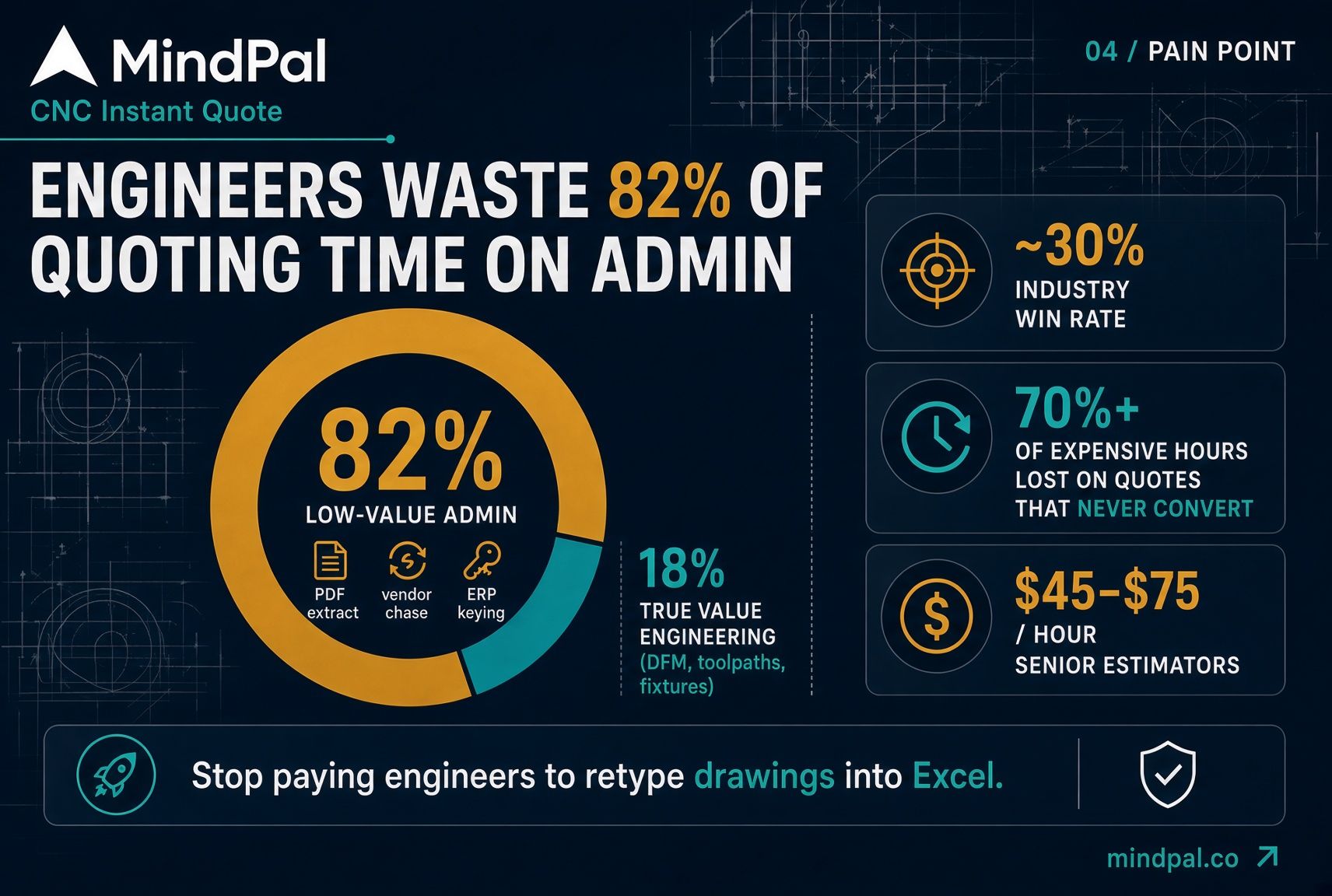
- Industry average of three working days: around 30%
- Five days or more: 12-20%
Wait five days and you cut your chances almost in half. The first shop to land a clean quote on the engineer’s desk often locks 70% of the repeat volume on commodity parts.
McKinsey data shows that simply getting under 48 hours lifts win rate by about 25%. That’s not a small tweak. That’s the difference between a shop that’s growing and one that’s treading water.
Two ways to lose money on the same quote
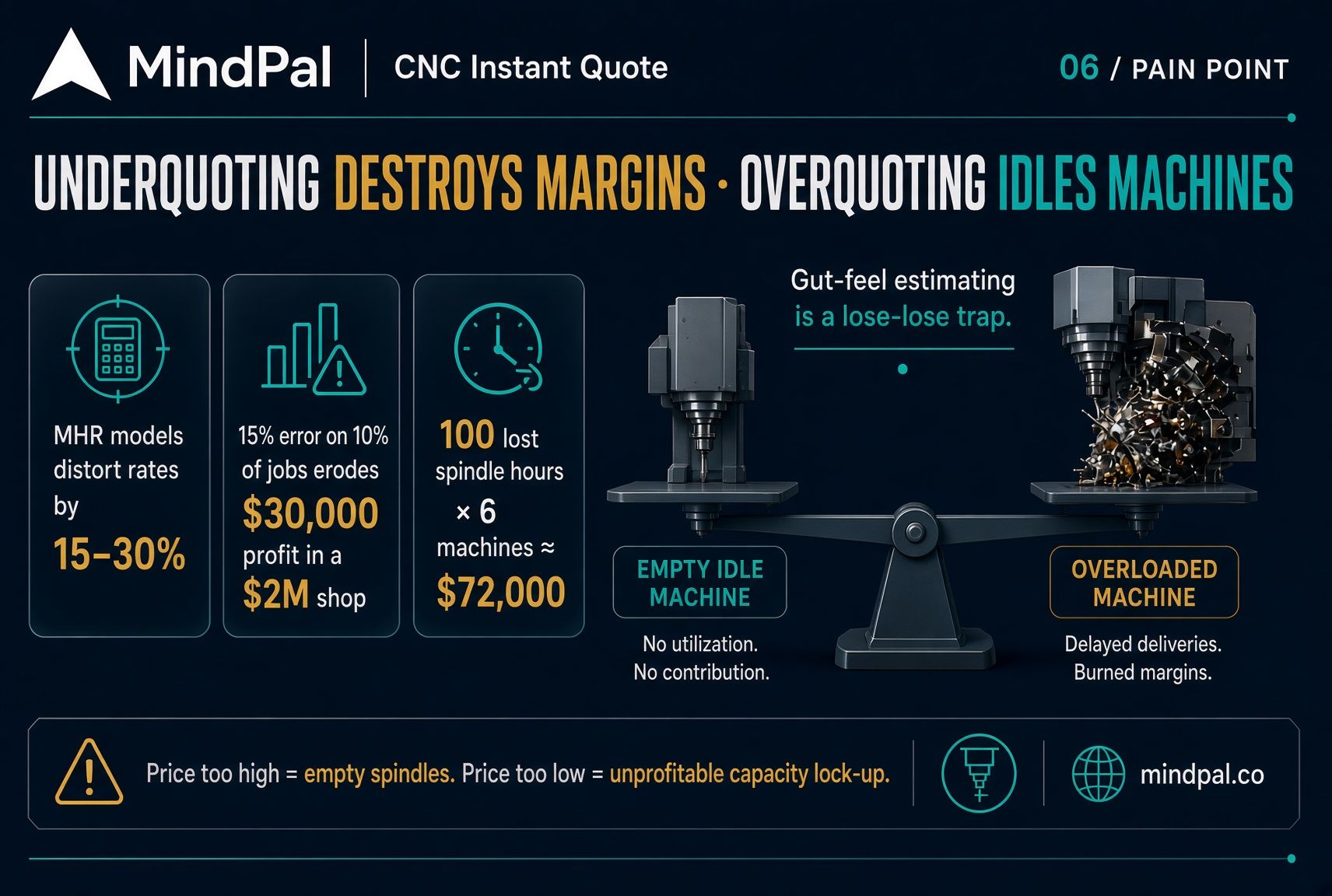
Underquoting is the winner’s curse. You win the job, then lock a machine on a contract that doesn’t cover real machine-hour rate, setup amortization, tool wear, or energy. A 15-30% error in machine hourly rate is common when shops use last year’s numbers and ignore actual spindle utilization, probe cycles, and tool changes. On a 100-hour 5-axis job, using $100/hour instead of the real $130/hour is a $3,000 hole before you even start.
Small-batch reality makes it worse. Median lot size in the U.S. is 35-48 pieces. Setup often eats more than 30% of the total time. Underestimate setup by three hours on a 30-piece run and every part carries a hidden $12 cost at $120/hour.
Overquoting is the defensive reaction. Unsure about Inconel tool life or a tricky fixture, the estimator slaps on a 20-40% fudge factor. The quote dies in the buyer’s comparison spreadsheet and the spindle sits idle. One hundred lost hours per machine per year on a six-machine shop is roughly $72,000 in revenue that never arrived to cover the lease.
Either way, traditional shops run 7–10 points of gross margin behind the leaders.
What the top 20% actually do differently
Gardner Intelligence Top Shops data is consistent year after year:
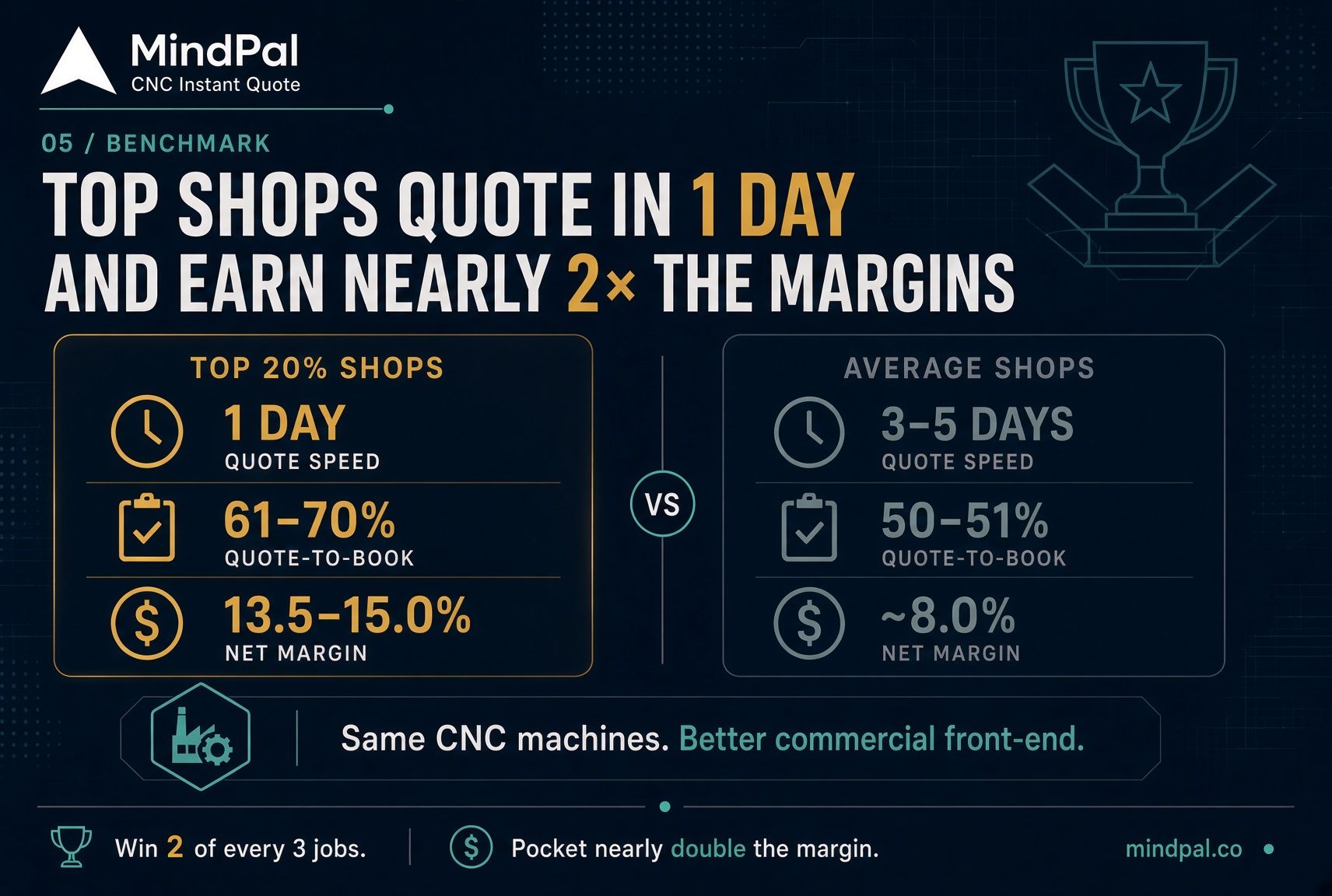
- Quote turnaround: one day or less vs. 3-5 days
- Quote-to-book: 61-70% vs. ~30-51%
- Net profit margin: 13.5-15% vs. ~8%
- Spindle utilization: 72-75% vs. 60-65%
- Sales per CNC machine: $350k vs. $183k
- Scrap and rework: 0.9% vs. 2.4%
They don’t win because they have cheaper labor. They win because they quote fewer losers and spend engineer time on DFM instead of hunting through PDFs and calling coating houses. High-performance shops also show 9 points higher gross margin and 10 points higher overall profitability, with lower overhead, not lower wages.
Why the old process is structurally broken
Eighty percent of RFQs still arrive unstructured: email, low-res PDF, hand sketch, incomplete 3D model. The workflow is sequential. You wait two days for the anodize quote and the whole estimate sits. Knowledge lives in one senior guy’s head. Then someone re-types numbers from the spreadsheet into JobBOSS and a tolerance gets missed.
Engineers spend 82% of quoting time on friction (reading drawings, chasing material prices, punching data into ERP) and only 18% on actual engineering. At 25-30% win rates, most of that expensive time is spent on jobs you will never run.
The fix is not “work faster.” It’s stop doing it by hand.
Shops that moved to geometry-based quoting (feature recognition on the CAD model plus rule-based costing) cut quote time 60-92%. Three-to-five-day jobs become four hours or minutes. They process two to three times more RFQs with the same headcount. Win rates rise 18-30%. The 5% revenue leak disappears. Some pick up extra $40k in expedite premiums in the first quarter just because they can now price a one-week delivery against a four-week one.
Accenture and Aberdeen numbers line up: mature quoting systems add 5-10% revenue and shorten the sales cycle 28%, while lifting baseline win rate about 17%.
The shops that treat quoting as a precision engineering-and-finance process, not a necessary evil, are the ones holding 15% margins and growing 12–18% while everyone else grows 0–3%. In a reshoring market with tight capacity, the first accurate quote usually wins. Everything else is just hoping the buyer waits.
Tom Teluk
PR & Marketing Head
tom@mindpal.co
Do not miss ConTech Webinars! => https://construction.mindpal.co/webinar
Need a free audit/consultation? Reply => https://construction.mindpal.co/audit
Share this blog post via
Read other articles
1 / 0
FOR BUSINESS
Manufacturing for construction
Recruitment
FOR INDIVIDUALS
SOLUTIONS

This site is protected by reCAPTCHA and the Google Privacy Policy and Terms of Service apply.
Copyright © MindPal 2026. All Rights Reserved.