June 22, 2026
Resume Statistics Every US Job Seeker Needs to Know
11 min read
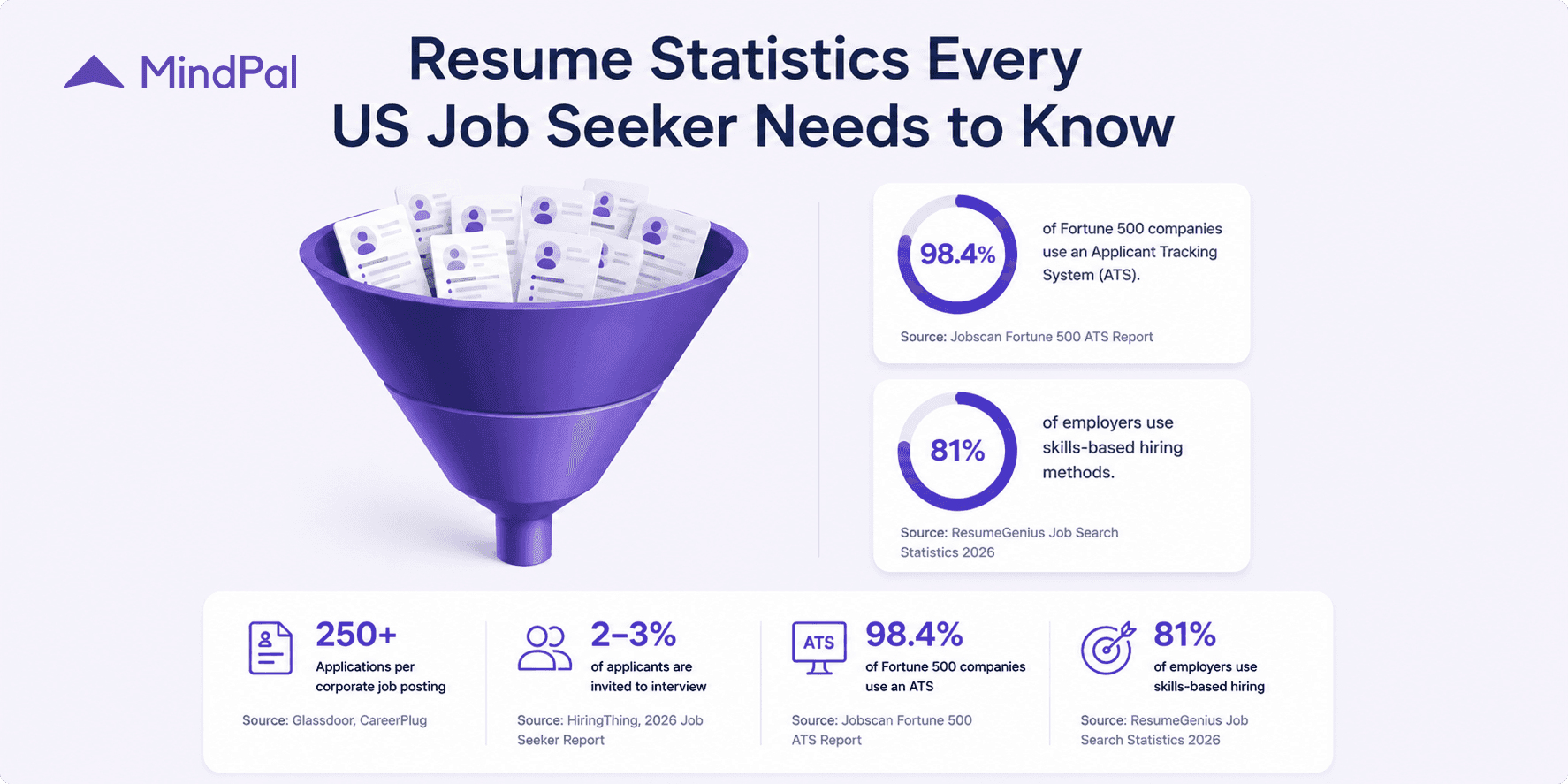
These statistics explain something most job seekers never find out: why a strong resume gets no response. The numbers below show exactly what happens to your application before a recruiter ever reads your name - and why your resume may be getting rejected before it reaches a human.
In this article, you'll discover:
- How many Americans are actively job searching right now. Real BLS numbers.
- What 98.4% of Fortune 500 companies have in common, and why it matters for your resume
- How long a recruiter actually spends on your resume (the answer is more nuanced than you've heard)
- The real reason resumes don't get responses, it's not what most career blogs say
- Why your industry changes your ATS results entirely. Tech vs Healthcare data.
- The one resume change with the highest proven impact on interview callback rates
- How to check your ATS score for free right now
There are 7.3 million Americans actively looking for work right now. The unemployment rate sits at 4.3%.
Source: US Bureau of Labor Statistics, Employment Situation Summary, May 2026
Most of those job seekers are applying to the same corporate roles, on the same platforms, competing against hundreds of other applicants per posting. The data behind this process is uncomfortable. But once you understand it, you can stop guessing and start fixing.
The statistics below show exactly what is happening at scale in the US job market in 2026, and what you can do about it.
What ATS Actually Does, and What It Doesn't
You may have seen the claim that "75% of resumes are rejected by ATS before a human reads them." It is one of the most widely shared statistics in career advice.
It is also not supported by any published research.
The figure originated from a 2012 sales pitch by a company called Preptel, which went out of business in 2013. No methodology, no study, no data. The number has been copied across career blogs for 14 years.
Source: HR Gazette: Debunking the ATS Rejection Myth
What is real: Enhancv interviewed 25 US recruiters across tech, healthcare, and finance and found that 100% use ATS for compliance screening, but only 8% configure content-based automatic rejection. The rest make decisions based on volume. They simply cannot read every resume.
Source: Enhancv, in-depth interviews with 25 US recruiters, 2025–2026
This distinction matters. Your resume is not being rejected by a robot. It is being skipped by a human who has 249 other files to get through. That is a different problem, with a different solution.
How Recruiters Actually Read Your Resume
The reality of how long a recruiter spends on a resume is more layered than the "6 seconds" figure most people cite:
• Initial scan: 5–7 seconds to decide whether to keep reading
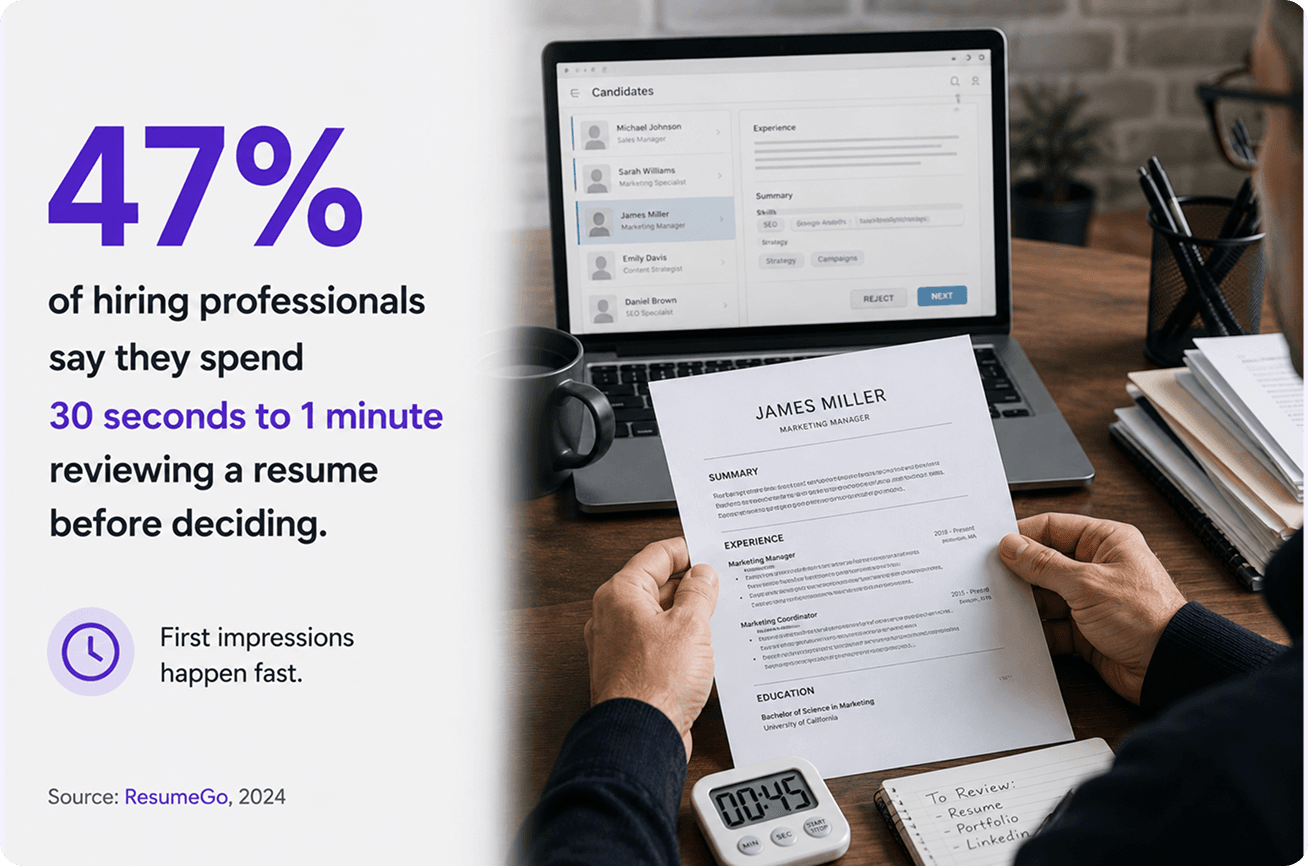
• 47% of hiring professionals say they spend 30 seconds to 1 minute reviewing a resume before deciding
• Median full review time: 1 minute 34 seconds for candidates who pass the first scan
• 78% of recruiters rate "skim-ability" as highly important when reviewing a resume
• The top 25% of your resume captures 80% of recruiter attention: name, job title, first role, skills
Source: ResumeGo survey of 418 US hiring professionals, 2024 · InterviewPal study of 4,289 resume reviews across 312 recruiters, August 2025
The top third of your resume (summary, skills section, first bullet of your most recent role) determines whether the remaining two-thirds are ever read. That is where the work happens.
The One Resume Change With the Highest Proven Impact
Of all the available resume statistics, this one has the clearest implication for what to do next:
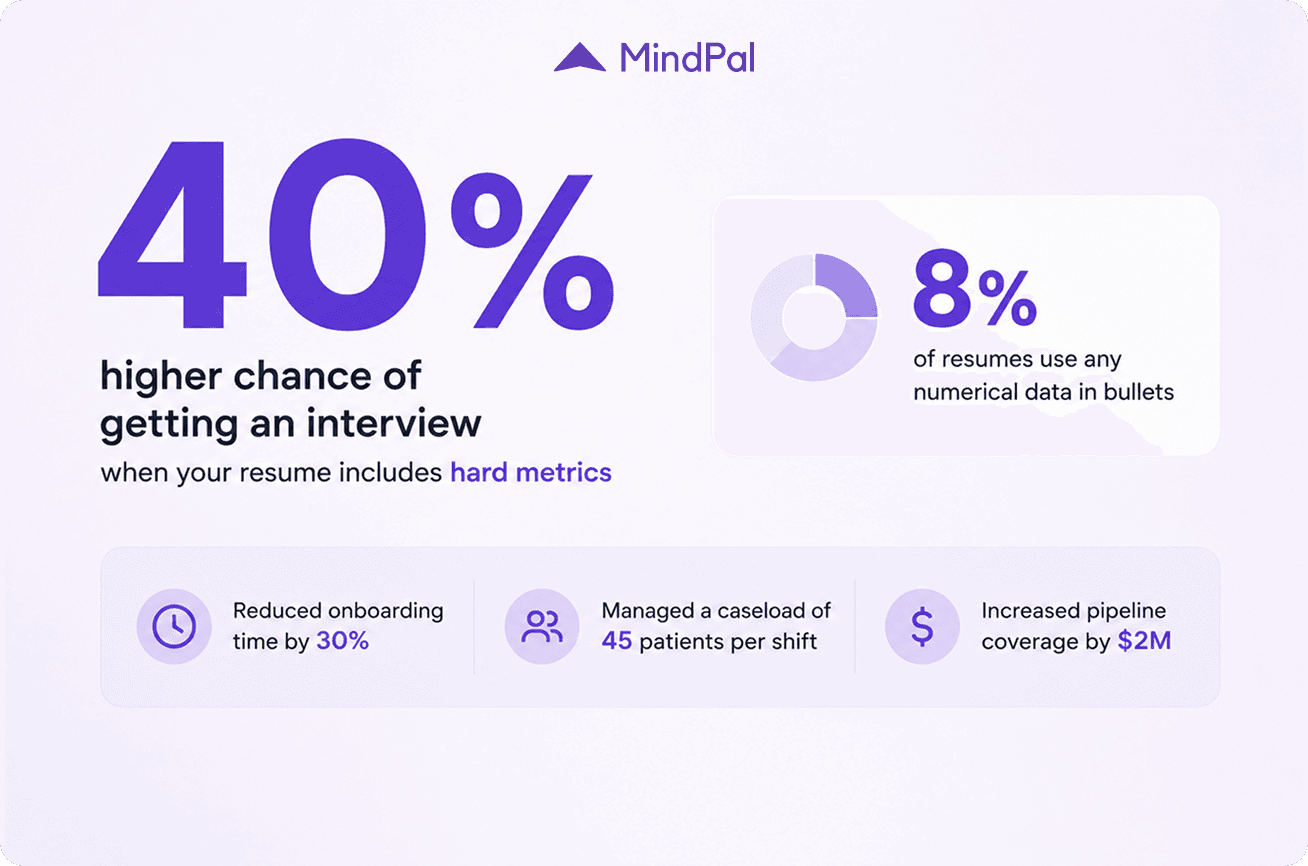
Quantified results like "reduced onboarding time by 30%", "managed a caseload of 45 patients per shift", "increased pipeline coverage by $2M" are the single highest-impact change available to most US job seekers. They pass ATS keyword matching, they hold a recruiter's attention during the 5-second scan, and they communicate seniority level instantly.
The reason only 8% of resumes include them: most people do not think of their work in numbers. The fix is to add 3–5 quantified bullets to your most recent role. That alone puts your resume ahead of 92% of the competition.
Why Your Industry Changes Everything
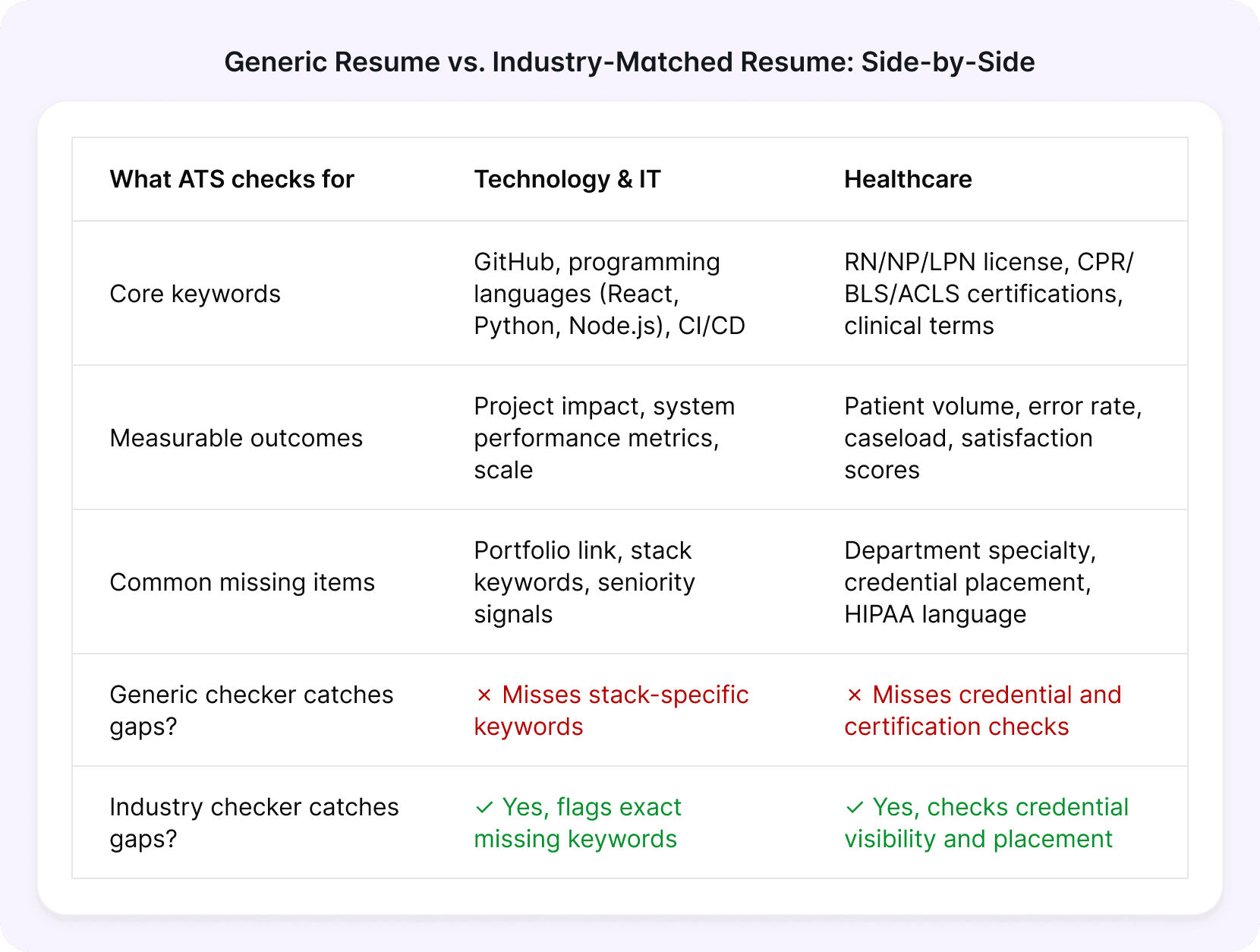
A resume that scores well on a generic ATS check can score significantly lower when checked against industry-specific requirements. The same resume. Two different results. Here is why:
| What ATS checks for | Technology & IT | Healthcare |
| Core keywords | GitHub, programming languages (React, Python, Node.js), CI/CD | RN/NP/LPN license, CPR/BLS/ACLS certifications, clinical terms |
| Measurable outcomes | Project impact, system performance metrics, scale | Patient volume, error rate, caseload, satisfaction scores |
| Common missing items | Portfolio link, stack keywords, seniority signals | Department specialty, credential placement, HIPAA language |
| Generic checker catches gaps? | ✗ Misses stack-specific keywords | ✗ Misses credential and certification checks |
| Industry checker catches gaps? | ✓ Yes, flags exact missing keywords | ✓ Yes, checks credential visibility and placement |
This is why industry-specific resume checking matters. ATS platforms at large US employers (hospital systems, tech companies, financial institutions) are configured with role-specific keyword sets. Generic checkers apply the same rules to everyone and miss the gaps that are actually causing your rejections.
AI Has Changed Both Sides
Two shifts specific to affect every US job seeker right now:
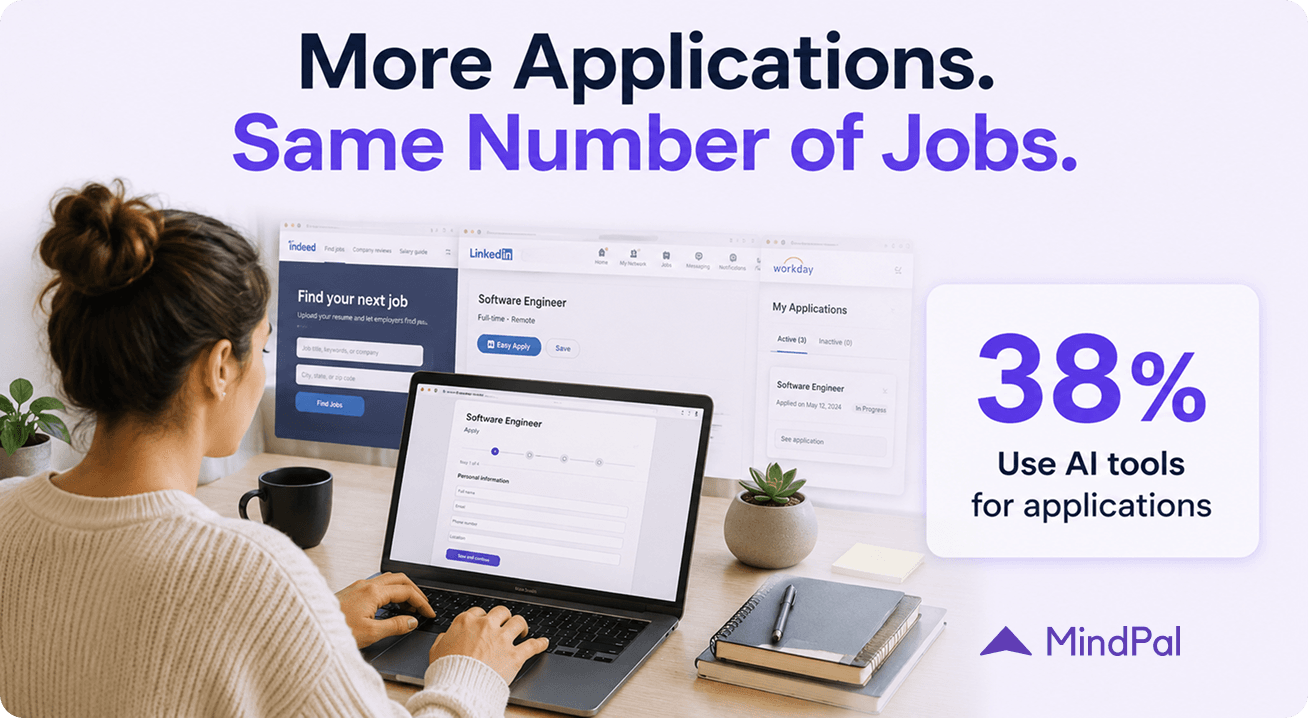
More applications, same number of jobs
38% of US job seekers now use AI tools to help with applications, including generating cover letters, tailoring resumes, mass-applying across platforms.
Source: ResumeGenius Job Search Statistics 2026
The result: application volumes per posting are higher than in previous years. 81.6% of recruiters have already encountered AI-written cover letters. This raises the bar for what a human-sounding, tailored resume looks like.
Skills matter more than credentials
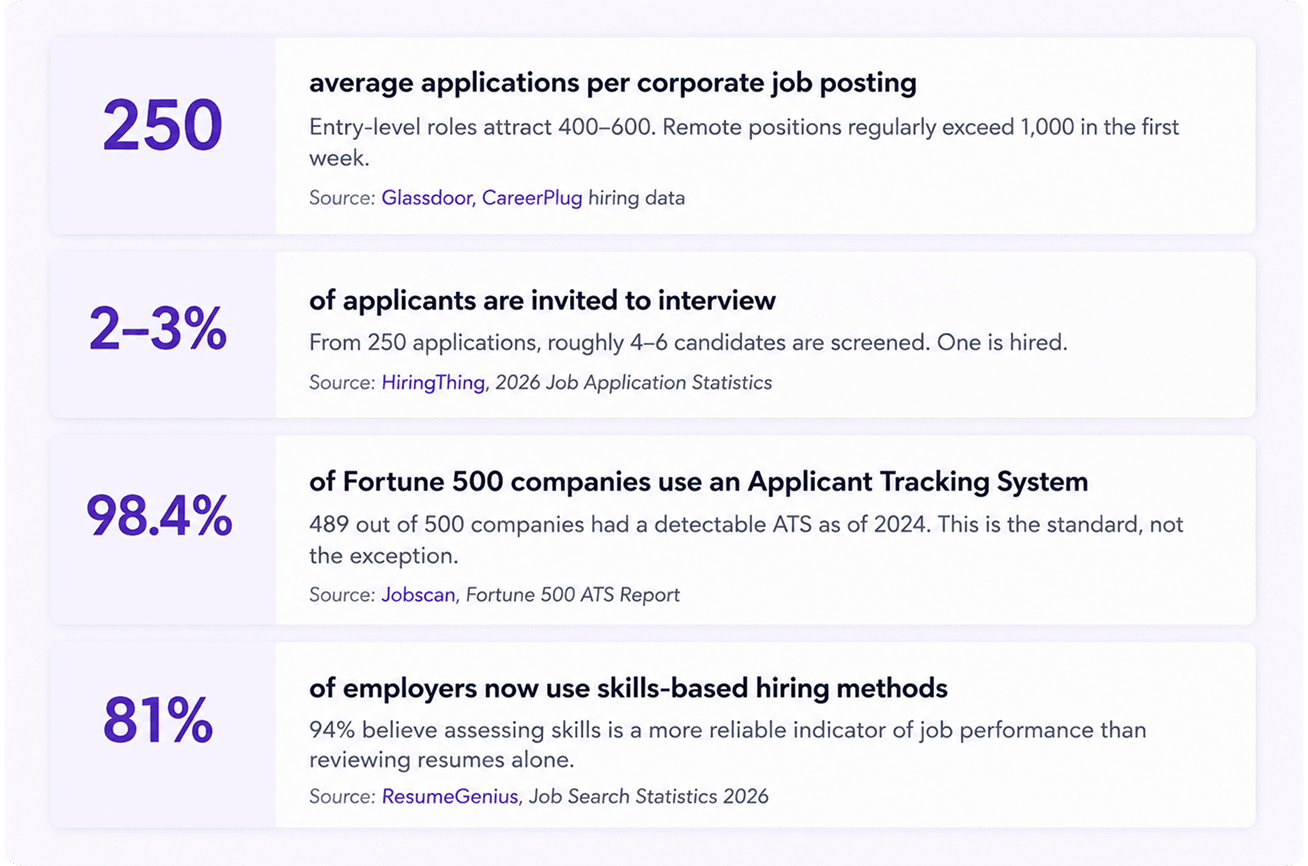
81% of employers use skills-based hiring. 94% say skills assessment is more reliable than resume review alone. 86% hire for experience over education.
Source: ResumeGenius Job Search Statistics 2026
This means: a resume that clearly demonstrates skills through specific, measurable accomplishments outperforms one with impressive credentials and vague descriptions, every time.
What to Do Right Now
The data points to one conclusion: a resume tailored to the specific job, with measurable accomplishments and the exact keywords the role requires, will always outperform a generic one. That is not an opinion. It is what the hiring data shows.
The fastest way to know where your resume stands: check your ATS score before you apply.
→ Check your ATS resume score, one free
Frequently Asked Questions
What percentage of resumes actually reach a recruiter?
98.4% of Fortune 500 companies use an ATS, meaning your resume is parsed and ranked before a human sees it. But automatic rejection by software is less common than widely reported, most filtering happens because recruiters simply cannot read 250+ resumes per posting and prioritize the most relevant ones. Source: Jobscan Fortune 500 ATS Report.
Is the '75% rejected by ATS' statistic real?
No. This figure originated from a 2012 sales pitch by a company that no longer exists, with no published methodology or study behind it. It has been repeated across career blogs since then. What is real: 98.4% of Fortune 500 companies use ATS (Jobscan, 2024), and only 2–3% of applicants are invited to interview from an average posting of 250 applications (HiringThing, 2026).
What is the most effective change I can make to my resume?
Adding hard metrics to your experience bullets. Resumes with quantified results have a 40% higher chance of earning an interview, yet only 8% of resumes currently include numerical data (Enhancv, 2026). Three to five quantified bullets in your most recent role puts your resume ahead of the vast majority of applicants.
Does industry matter for ATS scoring?
Yes, significantly. ATS platforms at large US employers are configured with industry-specific keyword requirements. A tech resume must show GitHub links and programming language proficiency. A healthcare resume must front-load license abbreviations and certifications. A generic resume checker applies the same rules to both and misses the industry-specific gaps that cause rejections. MindPal's industry checker is built specifically for Technology & IT and Healthcare roles.
How do I know if my resume is ATS compatible?
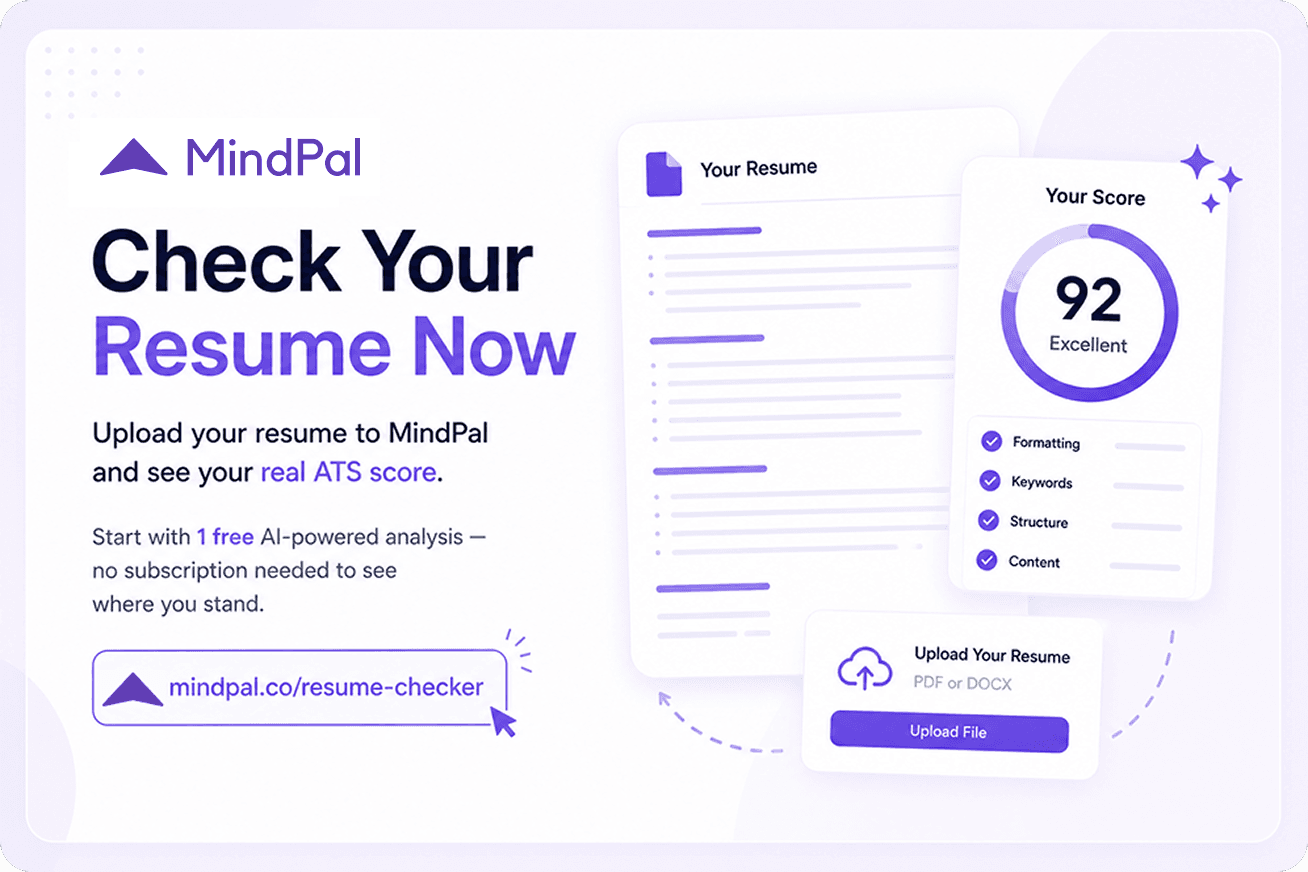
Run it through an ATS resume checker that simulates real parsing and scoring. MindPal shows your score immediately after upload with a breakdown of what is failing and what to fix, no account required. Visit mindpal.co/resume-checker.
How has AI changed job searching in 2026?
38% of US job seekers now use AI to help with applications, including resume writing and tailoring. This has increased application volumes per posting, making the bar for a standout resume higher. 81.6% of recruiters have already encountered AI-written cover letters (ResumeGenius, 2026). The most effective strategy: use AI tools to improve your resume and identify keyword gaps, not to generate generic content that looks like everyone else's.
Sources
- US Bureau of Labor Statistics, Employment Situation Summary, May 2026
- Jobscan, Fortune 500 ATS Usage Report 2024
- HiringThing, 2026 Job Application Statistics
- ResumeGenius, Job Search Statistics Report 2026
- Enhancv, 170+ Resume Statistics for Job Seekers 2026
- InterviewPal, How Long Recruiters Actually Spend Reading Resumes (study of 4,289 reviews), August 2025
- ResumeGo, Recruiter review time survey of 418 US hiring professionals, 2024
- HR Gazette: Debunking the ATS Rejection Myth
- MindPal resume checker online, AI resume review and ATS score checker at mindpal.co/resume-checker
Try MindPal's AI Resume Checker
Upload your resume to MindPal Resume Checker at mindpal.co/resume-checker. Your first AI analysis is free.
Your resume is private and secure. Start with 1 free AI analysis.
Disclaimer: All product names are property of their respective owners. Informational purposes only. Data: MindPal Q1 2026.
Olga Nazarenko,
UX UI Designer,
MindPal.co
Share this blog post via
Read other articles
1 / 0
FOR BUSINESS
Manufacturing for construction
Recruitment
FOR INDIVIDUALS
SOLUTIONS

This site is protected by reCAPTCHA and the Google Privacy Policy and Terms of Service apply.
Copyright © MindPal 2026. All Rights Reserved.