May 12, 2026
Automation and AI Implementation in the American ConTech Sector
7 min read
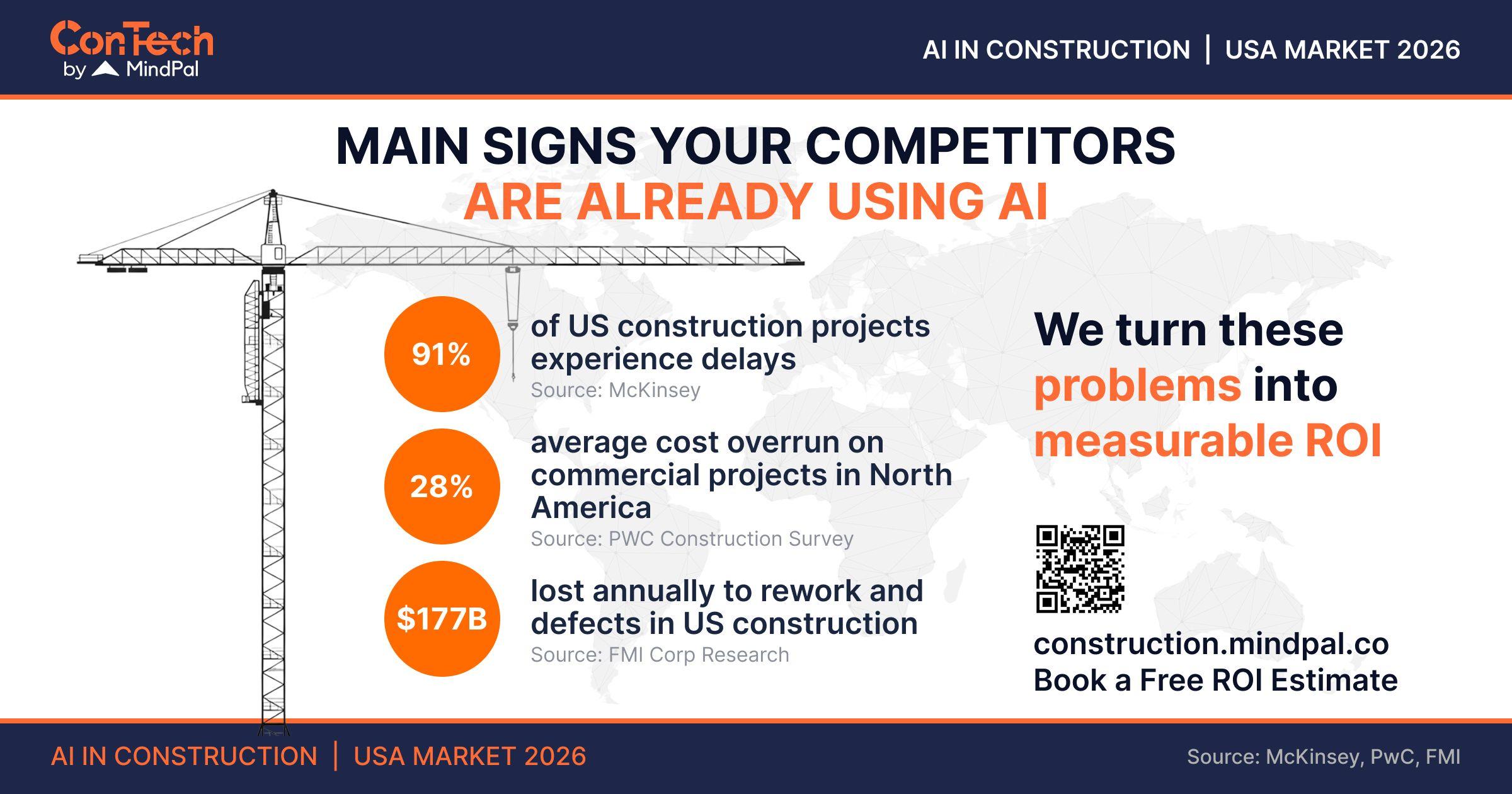
The Engineering and Construction (E&C) sector in the United States entered the year 2026 in an atmosphere of strong economic pressure, which became a catalyst for long-delayed digital transformation.
Data analysis from the second quarter of 2025 indicates the sector's real value added at a level of 890 billion USD, with total gross output reaching 1.732 trillion USD. Despite these impressive figures, the industry stands at a critical turning point: rising material costs, chronic labor shortages, and shifting project demand are forcing a departure from traditional operating methods in favor of advanced construction technologies, collectively referred to as ConTech.
By 2026, this market is evolving toward data-driven structures, where Building Information Modeling (BIM) is no longer just a design tool but is becoming the operational foundation for the entire investment life cycle. The largest growth impulse currently comes from critical infrastructure segments, including data centers driven by the development of artificial intelligence and energy projects, while traditional commercial construction shows signs of a slowdown.
This article analyzes in detail the reasons for the sector's historical technological lag, barriers in management awareness, and measurable implementation successes that define a new era of American construction.
Reasons for Structural Delay in Construction Automation
Historically, construction remains one of the least automated industries in the U.S. economy, contrasting drastically with the dynamics of the financial or manufacturing sectors. While the manufacturing industry has been implementing Industry 4.0 concepts for decades, construction struggles with challenges that hinder the standardization necessary for mass automation.
A comparative analysis of Information Technology (IT) spending reveals a deep gap between construction and digitization leaders. Construction companies have historically allocated less than 1% of their revenue to IT, which is only one-third of the spending recorded in the automotive or aerospace industries. The financial sector, at the opposite end, invests an average of 10% of revenue in technological transformation, resulting in a digitization score of 4.5 on a five-point scale, while construction oscillates near the lowest values.
Table 1. Comparison of Digitization Levels and Innovation Spending
| Industry | Average IT Expenditure (% of revenue) | Digital Maturity Index (1-5 scale) | Full Automation Level (2025/26) |
| Financial Services | 10% | 4.5 | 36% |
| Manufacturing | 3-5% | 3.9 | 29% |
| Energy | 4% | 3.7 | 25% |
| Construction (AEC) | <1% | 2.8 | <5% |
Source: Own study MindPal.co based on data from Deloitte, McKinsey, and Integrate.io.
Physical Barriers and Process Fragmentation
The primary cause of the low level of automation is the nature of the construction site. Unlike the controlled environment of a factory floor, where robots can perform repetitive tasks under constant conditions, a construction site is a dynamic, unstructured environment subject to atmospheric influences. Every construction project is, in fact, a prototype, which means automation algorithms must handle a vast number of variables that cannot be fully predicted at the programming stage.
However, this apparent chaos can be organized. Based on the Return on Investment (ROI) index, areas where automation will be profitable can be identified.
Another factor favoring automation is the fragmentation of the supply chain and process participants. A typical construction project involves dozens of subcontractors, each operating on their own, often incompatible, data systems. It is estimated that the average construction enterprise uses about 11 different data environments, leading to information silos and preventing the implementation of integrated AI systems, which require consistent and clean datasets to function effectively. In the financial sector, data standardization is forced by rigorous regulations, enabling the rapid implementation of predictive algorithms and automated transaction systems.
Additionally, the construction industry is characterized by low margins, which discourages taking investment risks on uncertain technologies. While 92% of leaders in the manufacturing sector believe that smart production is a key driver of competitiveness, digital transformation in construction has long been perceived as a cost rather than an investment generating a return.
Low Management Awareness and Competency Barriers
Low awareness among construction industry leaders regarding the potential of automation is one of the most significant inhibitors of ConTech development in the US in 2025–2026. Research indicates that although interest in artificial intelligence is growing, real knowledge of its practical application remains limited to a narrow group of innovators.
2025 reports indicate that only 27% of Architecture, Engineering, and Construction (AEC) professionals declare active use of AI in their operations. Furthermore, as many as 45% of respondents admit that no AI-based solutions have been implemented in their organizations, and 34% are only in the early pilot phase. In comparison, 97% of leaders in the technology sector consider AI an absolute strategic priority.
Table 2. Awareness and Organizational Readiness Statistics
| Attitude of Leaders Toward AI | Construction Industry (2025) | Technology Sector (2025) |
| Recognizing AI as a strategic priority | 32% | 97% |
| Lack of any implementation | 45% | <10% |
| Belief in productivity improvement | 31% | 80% |
| Fear of industry destabilization | 47% | <20% |
Source: Own study MindPal.co based on data from RICS, Autodesk, and EY.
Analysis of the reasons for this state reveals a deep lack of digital competencies. The lack of qualified personnel is the most frequently cited implementation barrier, noted by 46% of respondents. Many heads of construction companies, raised in a traditional management model, view automation through the lens of risks to process stability rather than opportunities to improve margins.
This argues for outsourcing automation tasks using AI tools. Instead of hiring very expensive specialists on the market, it is much more cost-effective to turn to an external provider with a track record of successful implementations and experience. An outside perspective and expert consulting will be invaluable in choosing a model that is most rational and profitable from a business management perspective.
Management Risk Gap and Shadow AI
An interesting phenomenon escaping the attention of many CEOs is "Shadow AI"—a situation where lower-level employees implement AI tools without official consent or supervision. 2026 research shows that 52% of AI initiatives at the departmental level operate without formal approval, creating a huge risk of sensitive data and intellectual property leaks. The lack of central control over digital transformation in construction companies means that leaders are unaware not only of the benefits but also the threats, further deepening their reluctance toward systemic changes.
Management awareness is also limited by the difficulty in quantifying the Return on Investment (ROI). Unlike purchasing an excavator or crane, where the depreciation schedule is predictable, investments in AI often deliver value in areas difficult to measure, such as better communication or fewer design conflicts. This makes company heads, who are under the pressure of quarterly financial results, less likely to commit to long-term technological projects.
Tom Teluk
PR & Communications Manager
ConTech by MindPal
contech.mindpal.co
e-mail: tom (at) mindpal.co
LinkedIn: https://www.linkedin.com/in/tomasz-teluk-273b917a/
Share this blog post via
Read other articles
1 / 0
This site is protected by reCAPTCHA and the Google Privacy Policy and Terms of Service apply.
Copyright © MindPal 2026. All Right Reserved.